IATF 16949
About IATF 16949
IATF 16949 Certification – Quality That Holds Up on the Production Line
Table of Contents
Most suppliers we talk to call us after something went wrong. An OEM audit found a gap. A customer chargeback landed. A new program needs IATF 16949 certification by a date nobody can move. The calls sound different but the problem underneath is usually the same: the quality system exists on paper, and the shop floor does its own thing.
IATF 16949 is the automotive quality standard. It sits on ISO 9001 and adds rules for defect prevention, variation, supplier control and each customer’s own requirements. We train your people and test your readiness before the formal audit. We don’t build your system, and we’ll say why below.
What IATF 16949 certification really asks
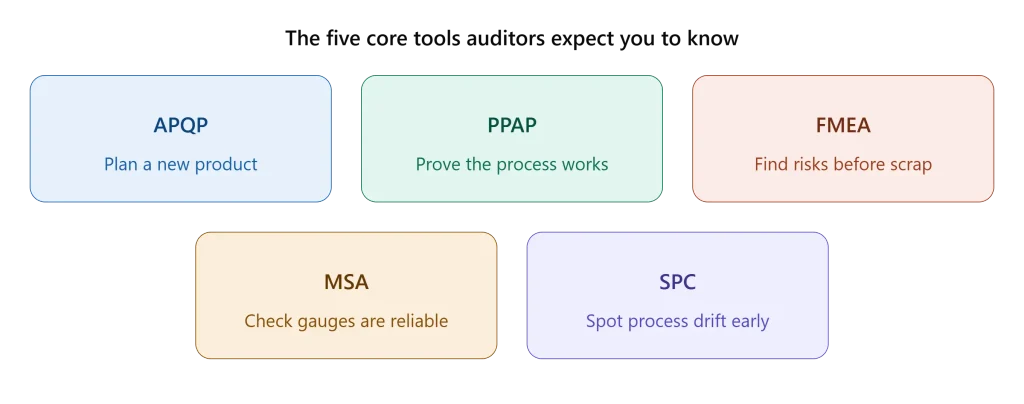
ISO 9001 wants to know whether your system works. IATF 16949 certification wants to know whether it stops defects in a plant making thousands of parts a day to tight tolerances. Auditors spend their time in a handful of places.
The core tools get the most attention. APQP, PPAP, FMEA, MSA and SPC. Know them well enough to explain, not just to fill in templates. Control plans come next, and they have to match the process on the line today, not the one from launch. Suppliers matter because a sub-supplier’s defect lands on you. Product safety, contingency plans and layered process audits are all checked. And then there are customer-specific requirements. Every OEM has its own. Most suppliers underestimate them.
Who can issue the certificate
Worth being clear. IATF 16949 certificates are issued only by certification bodies recognised by the IATF, and they’re logged in the IATF database. Our part is training, readiness checks and mock audits. Before you commit to anything, confirm which recognised body will run the certification audit, and check your customer accepts that body.
Why suppliers go for IATF 16949 certification
The honest first reason is that customers demand it. Plenty of OEMs and Tier 1 companies won’t onboard a supplier without IATF 16949 certification. Some won’t keep one that lost it. It tends to end the conversation before price comes up.
Second, escapes, which IATF 16949 certification is built to prevent. A single bad lot reaching an OEM line can mean sorting, a stopped line and chargebacks. Prevention is cheaper.
Third, stability. When the process is controlled, quality no longer depends on who is working that shift.
Who needs IATF 16949 certification
Makers of automotive production parts, service parts and accessories. Castings, forgings, machined parts, stampings, moulded parts, wiring, electronics, and the heat-treat and coating shops that work for them. Some support sites, like design centres, can be covered through the plant they serve. If you’re a small shop trying to get on a Tier 1’s approved list, ask what they expect from you first. It saves a lot of guessing.
How the IATF 16949 certification process works
Here is our part of the IATF 16949 certification route, in order.
- Enquiry and scoping. What you make, where, and for which customers. We work out which OEM requirements apply to you.
- Team and auditor training. Staff learn the standard and the core tools. Internal auditors learn the three audit types: QMS audit, manufacturing process audit and product audit.
- Mock audit. A rehearsal on the shop floor and in the documents. Better to find a problem now than in front of the auditor.
- Certification audit. A two-stage audit by an IATF-recognised certification body. Documents first, then on-site implementation.
- Certificate and ongoing support. Once findings are closed, the recognised body issues the certificate. We help with surveillance preparation and auditor refresher training.
We don’t do consulting or system design. Someone who designed your system shouldn’t audit it. OEMs know that, and they watch for it.
What a mock audit looks like
People expect a lecture. It’s closer to a real visit. An auditor walks the line, picks a job at random, and asks the operator how they know the part is good. Then they ask to see the control plan, the last gauge calibration and the reaction plan for a failed check. Gaps get written up exactly as they would in a formal audit, so you can fix them without any consequence for your certificate. Many suppliers tell us the mock audit teaches the team more than the classroom sessions did, and it makes IATF 16949 certification feel far less like a leap in the dark.
The usual findings before IATF 16949 certification
Control plans out of step with the process. An FMEA written for PPAP and never updated after a complaint. Gauges with no valid calibration or MSA study. Internal auditors never formally qualified for the audit type they run. Customer-specific requirements nobody has read. Corrective actions closed with “operator retrained” and no root cause.
Try this before IATF 16949 certification: pick one part number and follow it from customer requirement to FMEA, control plan, work instruction, gauge and record. The gaps appear fast. It takes an afternoon, not a week.
What you get from IATF 16949 certification
Customer access. Fewer escapes and chargebacks. Tighter control of changes. A team that goes after root cause instead of blame. In a couple of years you’d expect fewer complaints and less firefighting. The benefit of IATF 16949 certification tends to outlast the certificate.
Why ISPL
We’re an EGAC-accredited certification body with years of ISO training and audit work. For IATF 16949 certification readiness we offer training on the standard and core tools, internal auditor training, mock audits and follow-up support.
Getting started
How long IATF 16949 certification takes depends on where you begin. A supplier already on ISO 9001, with controlled documents and working control plans, moves faster than one still building basic records. Certificates last three years, with surveillance audits between.
Want to know what IATF 16949 certification would involve for your plant? Send us your products, sites and the OEMs you supply. We’ll outline a training and readiness plan.
Contact us
Phone: +91-9990477631 Email: info@isplcmmi.com
Get Expert Guidance
Fill out the form and our experts will get in touch with you.
Explore Other ISO Standards
ISO 9001Quality Management System ISO 14001
Environmental Management System ISO 45001
Occupational Health & Safety Management ISO 27001
Information Security Management ISO 22000
Food Safety Management System ISO 50001
Energy Management System ISO 17025
Laboratory Management System ISO 13485
Medical Devices Quality Management IATF 16949
Automotive Quality Management ISO 22301
Business Continuity Management
Need Help Choosing?
Talk to our ISO consultants directly — happy to guide you to the right standard for your business.
☎ +91 - 9990477631 ✉ info@isplcert.com