ISO 17025 Certification
About ISO 17025 Certification
ISO 17025 Certification – Make Your Lab Results Hold Up
Table of Contents
Picture a client disputing a test report. Your analyst is sure the result was right. Then someone asks for the calibration record of the instrument, and it turns out the last one lapsed in March. Nobody can say which version of the method was used either. Suddenly “we’ve been doing this for twenty years” doesn’t help much.
That situation is what ISO 17025 certification support is built around. ISO/IEC 17025 is the international standard for testing and calibration labs, and it asks one thing above all: can you prove your results are reliable? ISPL trains your people and audits your lab for ISO 17025 certification support. We don’t write your procedures, and I’ll explain why further down.
What ISO 17025 certification looks at
Any lab that produces test, measurement or calibration results can pursue ISO 17025 certification. QC labs inside factories, water and environmental labs, food and pharma labs, pathology labs, calibration houses. Size doesn’t matter much. What matters is whether the numbers you report leave the building and somebody relies on them.
ISO 17025 certification touches two areas. The first is management: impartiality, confidentiality, document control, complaints, internal audits. The second is technical, and that’s where most findings land. Are your analysts trained and authorised for each method? Is every instrument calibrated and traceable to a recognised standard? Have your methods been validated, or at least verified for your lab? Do you calculate measurement uncertainty, or just quote a number? Can a report be traced back to raw data a year later?
Certification versus accreditation
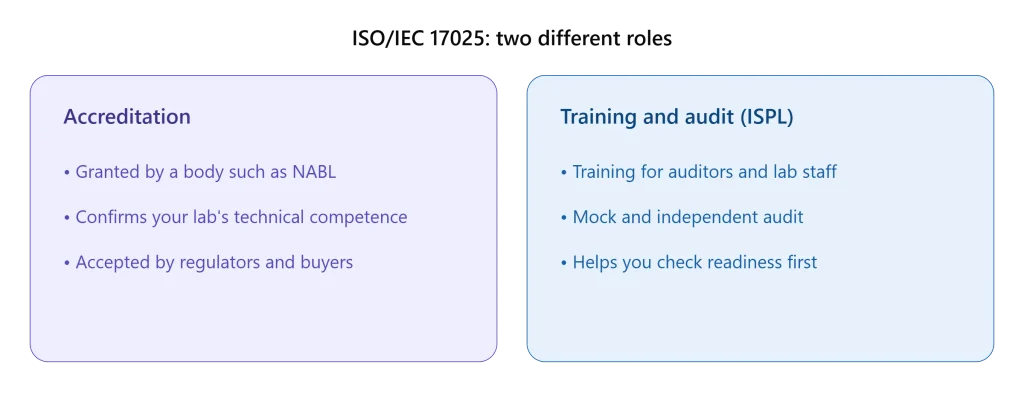
Quick but important point. In India, formal recognition of a lab’s competence under ISO/IEC 17025 is called accreditation, and a body such as NABL grants it. A certification body like ISPL audits and certifies. It doesn’t accredit labs. What we offer is training and an independent audit against the standard, which helps you prepare and check where you stand. Before you start, ask your client or tender which kind of recognition they actually want.
Why labs go for ISO 17025 certification
Mostly trust. Regulators and export buyers often accept reports only from labs that meet the standard. There’s also a very practical gain: when results are traceable, a dispute becomes a ten-minute check of records instead of a week of arguing.
Discipline improves too. Calibration schedules get followed, and a new analyst learns from written steps instead of copying a colleague’s habits. And many government and industry tenders ask for ISO 17025 certification or equivalent evidence before they’ll consider a lab at all.
Is ISO 17025 certification for you?
If you run a testing or calibration lab, and clients or regulators ask for proof of competence, probably yes. Same if your reports have been questioned or rejected before, or you want contracts that require traceable results. A small in-house lab doing informal checks may not need ISO 17025 certification. A lab whose reports go to customers usually does.
How the ISO 17025 certification process works
Our role in ISO 17025 certification has two parts, training and audit. Here is the sequence.
- Enquiry and scoping. We learn which tests or calibrations are in scope, which sites and staff are involved, and what recognition you’re after.
- Auditor and team training. Your staff learn the requirements and how a laboratory audit is done, including technical records, uncertainty and traceability. We use lab examples, not only clause text.
- Mock audit. A rehearsal with the questions an assessor would ask, early enough that you can still fix things.
- Independent audit. Our auditors check your management and technical practices against ISO/IEC 17025, including a look at technical work and records.
- Report and follow-up. You get a clear audit report. Once findings are closed, we stay available for follow-up audits and for guidance on the next step with the relevant accreditation body.
You’ll notice consulting and system design aren’t here. If you need that, hire a different firm. Our view is simple: an auditor who wrote your procedures is marking their own homework, and assessors can tell. Keeping the roles apart is what gives the audit weight.
Where labs stumble before ISO 17025 certification
The same few things come up again and again. Calibration records have gaps, and an overdue instrument puts every result since then in doubt. Uncertainty isn’t calculated, or is calculated once and never revisited. Standard methods get used without any evidence the lab can run them properly. Raw data is unsigned or incomplete, so a result can’t be defended later. There’s no proficiency testing plan, or there is one but nobody acted on the results. And staff competence is assumed rather than recorded, when assessors expect written authorisation per analyst and per method.
Training before the audit clears most of this. That’s why training comes first in our ISO 17025 certification process.
What you get out of ISO 17025 certification
Credibility, mainly. After that, fewer rejected reports, quicker answers when a client queries a result, tighter control of equipment, and a team that runs each method the same way. Over a year or two you’d expect fewer retests and less time lost to arguments about results.
Why ISPL
ISPL is an EGAC-accredited certification body with years of ISO training and audit work behind it. For ISO 17025 certification support we offer training for auditors and lab staff, mock audits, independent audits against ISO/IEC 17025, and follow-up support afterwards.
Getting started with ISO 17025 certification
How long ISO 17025 certification takes depends on how organised your lab is today. A lab with calibration schedules, validated methods and complete technical records can move fast. A lab that runs on habit and memory has to build its records first.
Want to know what ISO 17025 certification would mean for your lab? Send us your scope of testing or calibration, staff count and sites, and we’ll outline a training and audit plan.
Contact us
Phone: +91-9990477631 Email: info@isplcmmi.com
Get Expert Guidance
Fill out the form and our experts will get in touch with you.
Explore Other ISO Standards
ISO 9001Quality Management System ISO 14001
Environmental Management System ISO 45001
Occupational Health & Safety Management ISO 27001
Information Security Management ISO 22000
Food Safety Management System ISO 50001
Energy Management System ISO 17025
Laboratory Management System ISO 13485
Medical Devices Quality Management IATF 16949
Automotive Quality Management ISO 22301
Business Continuity Management
Need Help Choosing?
Talk to our ISO consultants directly — happy to guide you to the right standard for your business.
☎ +91 - 9990477631 ✉ info@isplcert.com