ISO 22000 Certification
About ISO 22000 Certification
ISO 22000 Certification – Keep Food Safe, Build Consumer Trust
Table of Contents
A hygiene poster on the wall doesn’t stop contamination. ISO 22000 certification exists for organizations that want food safety to be more than a checklist — it gives you a structured Food Safety Management System (FSMS) built to control real risks across the entire supply chain, from production to the final consumer.
At ISPL, we help organizations get their teams trained and their food safety systems audited against ISO 22000, so the certification reflects practices that genuinely protect consumers, not paperwork assembled the week before an auditor shows up.
What ISO 22000 Certification Actually Covers
ISO 22000 certification is built on an international standard for managing food safety, and it fits any organization in the food chain — producers, manufacturers, packaging companies, or distributors. None of this is about avoiding contamination on paper. It’s about genuinely reducing the risk of food safety issues at every stage, through controls people actually follow on the floor.
Organizations pursuing ISO 22000 certification typically end up working through a handful of core areas: identifying hazards across the food supply chain, controlling contamination risks at critical points, meeting legal and regulatory food safety requirements, setting up clear hygiene and handling procedures, and building real employee awareness around food safety instead of a once-a-year poster refresh.
Why Pursue ISO 22000 Certification
There are a few concrete reasons food businesses go after this.
Fewer Food Safety Incidents — catching contamination risks before they reach consumers beats dealing with a recall afterward.
Consumer Trust — customers feel noticeably safer buying from a business that’s gone through independent certification, rather than one that simply claims to follow good hygiene practices.
Regulatory Compliance — staying ahead of food safety laws avoids scrambling to catch up after an inspection flags something.
Market Access — many buyers and retailers now list ISO 22000 certification as a baseline requirement before a supplier is even considered.
Who Should Consider ISO 22000 Certification
ISO 22000 certification tends to suit organizations that produce, process, or handle food products, need to meet a buyer’s or retailer’s safety requirements before signing a contract, want to reduce the risk of contamination or recalls, or are bidding for contracts that require food safety certification as a baseline. It’s also worth considering for growing food businesses, since informal hygiene habits that worked for a small kitchen team rarely hold up once volume, staff, and distribution expand.
How the ISO 22000 Certification Process Works
We keep our role narrow, focused on two things — training your team and auditing your system. Here’s how the ISO 22000 certification process actually plays out, step by step:
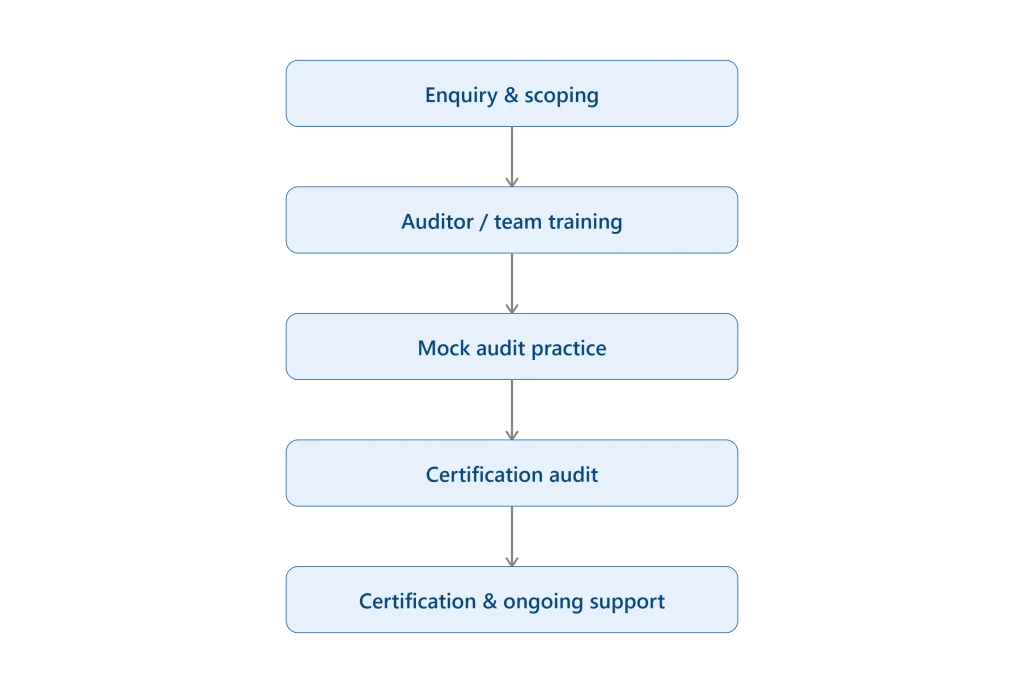
- Enquiry & Scoping — we understand your industry, current food safety practices, and what you’re aiming for with certification.
- Auditor / Team Training — your team gets trained on ISO 22000 requirements and how a food safety audit is genuinely conducted, not handed a generic hygiene refresher.
- Mock Audit Practice — a practice run so your team knows exactly what to expect going into the real audit.
- Certification Audit — our team conducts the formal, independent audit against ISO 22000 requirements.
- Certification & Ongoing Support — once the audit is cleared, certification is issued, and we stay available for surveillance and renewal audits afterward.
We don’t offer consulting, gap analysis, or FSMS design for ISO 22000 certification — that’s a different kind of firm, and it’s not our role. Keeping training and auditing separate from system design means the result stays independent and genuinely credible, since we’re never the ones building what we later audit.
What You Actually Get Out of It
Organizations that complete ISO 22000 certification typically see a reduced risk of contamination and recalls, stronger consumer and buyer trust, better regulatory compliance, improved supply chain coordination, and fewer food safety-related costs over time. There’s also a practical edge when bidding for retail or export contracts that specifically screen suppliers on this. Over a few years these gains tend to add up, since fewer incidents also mean less time lost to investigations, recalls, and rebuilding buyer confidence.
Why ISPL for ISO 22000 Certification
For ISO 22000 certification, we support organizations through training and audits — nothing more, nothing less, and that’s deliberate. It keeps our audits objective and keeps the result meaningful to buyers and regulators who actually check rather than glance at a logo.
Our Support Includes:
- Auditor and team training on ISO 22000 requirements
- Mock audit sessions that prepare your team for the real thing
- Formal, independent certification audits
- Ongoing guidance for surveillance and renewal audits after certification
Getting Started with ISO 22000 Certification
Ready to build safer food practices and stronger consumer trust, not just a compliance checkbox? We can train your team and audit your system through the entire ISO 22000 certification process, start to finish. Whether this is your organization’s first certification or a renewal, things move faster when you start with a clear scope and honest records rather than a scramble before a tender deadline.
Timelines for ISO 22000 certification vary by business size, product type, and how established your current hygiene and handling practices already are. A smaller packaged-food unit often moves through this faster than a larger processing plant running multiple shifts, simply because there’s less ground to cover during training and audit. Businesses that already maintain decent batch records and temperature logs tend to find the process smoother than those still relying on memory and handwritten notes. Once issued, ISO 22000 certification stays valid for three years, with a surveillance audit each year in between to confirm the system is genuinely being followed, not just documented once and forgotten.
Contact Us
Ready to move forward with ISO 22000 certification? Get in touch with our team, and we’ll walk you through exactly what training and audit plan fits your organization and industry.
Contact: +91-9990477631 | info@isplcmmi.com
Get Expert Guidance
Fill out the form and our experts will get in touch with you.
Explore Other ISO Standards
ISO 9001Quality Management System ISO 14001
Environmental Management System ISO 45001
Occupational Health & Safety Management ISO 27001
Information Security Management ISO 22000
Food Safety Management System ISO 50001
Energy Management System ISO 17025
Laboratory Management System ISO 13485
Medical Devices Quality Management IATF 16949
Automotive Quality Management ISO 22301
Business Continuity Management
Need Help Choosing?
Talk to our ISO consultants directly — happy to guide you to the right standard for your business.
☎ +91 - 9990477631 ✉ info@isplcert.com