 admin
Table of Contents
A buyer sends you a vendor form. Halfway down there’s a line: “ISO certified? Please attach a copy.” You don’t have one, and you’re not even sure which ISO they mean. Sound familiar? It happens to small business owners all the time, and it’s usually the moment they start searching for ISO Certification for Small Businesses.
The trouble is that ISO has a lot of standards, and the internet doesn’t make it easier. One page says get ISO 9001, another pushes 27001, and some consultants will happily sell you both. So let’s sort it out. Below you’ll find what each standard covers, who needs which, what it costs in time and money, and where most small companies slip up.
First, what does “ISO certified” really mean?
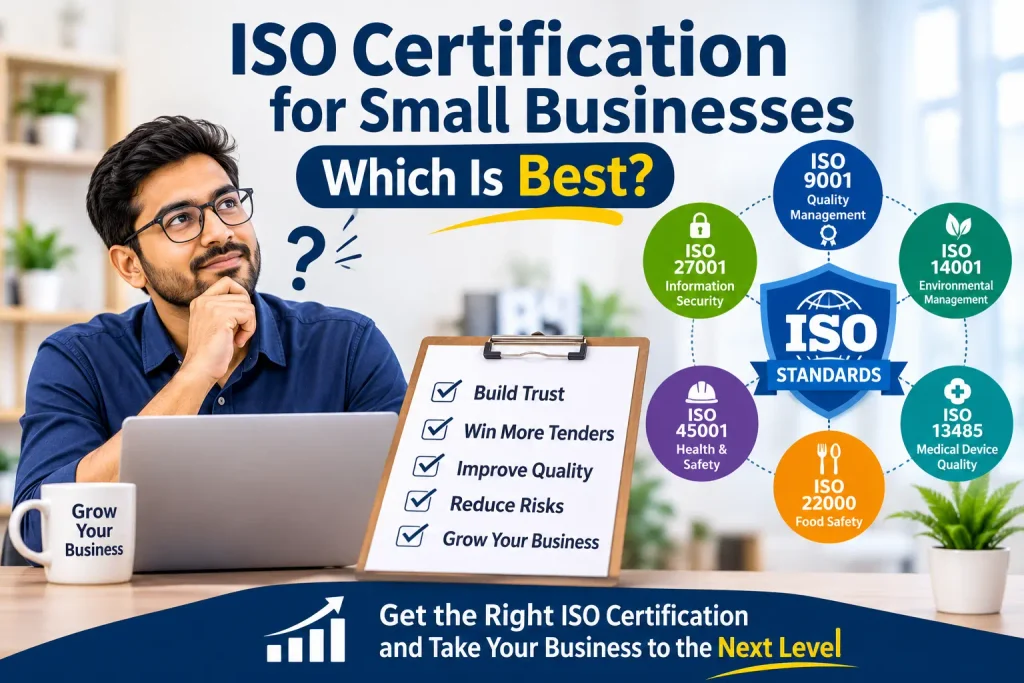
ISO is the International Organization for Standardization. It writes the standards but doesn’t hand out certificates. Certification bodies do that, and the good ones are accredited. If yours isn’t, the buyer who asked for the certificate may simply refuse it. Check this before you pay anyone.
During certification, an auditor looks at your records, talks to your staff and confirms you really follow the standard you claim to follow. That’s all there is to it. For a small firm, ISO Certification for Small Businesses works as outside proof that your way of working is organised.
Why ISO Certification for Small Businesses makes sense
A lot of owners think ISO is for big plants with hundreds of workers. Not true. The clauses are the same for everyone; you just apply them at your own scale. A 15-person company doesn’t need a 200-page manual.
What small firms usually get out of it:
- Bigger customers take your quotation more seriously
- You become eligible for tenders that list ISO as a condition
- Complaints and rework go down because processes are written down
- New staff learn faster since there’s a procedure to follow
- Your business stops depending on one person’s memory
The first tender you win because of the certificate often covers the whole cost. That’s the real value of ISO Certification for Small Businesses: it opens doors that stay shut otherwise.
The main ISO standards at a glance
Here’s a quick comparison of the standards that come up most often in ISO Certification for Small Businesses.
| Standard | What it covers | Good fit for | Who usually asks for it |
| ISO 9001 | Quality management | Traders, service firms, manufacturers | Corporate buyers, tenders |
| ISO 27001 | Information security | Software firms, BPOs, data handlers | Enterprise clients, banks |
| ISO 14001 | Environmental management | Factories, construction, waste handling | Export buyers, regulators |
| ISO 45001 | Health and safety at work | Plants, sites, warehouses | Large contractors |
| ISO 22000 | Food safety | Food processing, catering, packaging | Retail chains, exporters |
| ISO 13485 | Medical device quality | Device makers and suppliers | Regulators, hospitals |
So, which one is best?
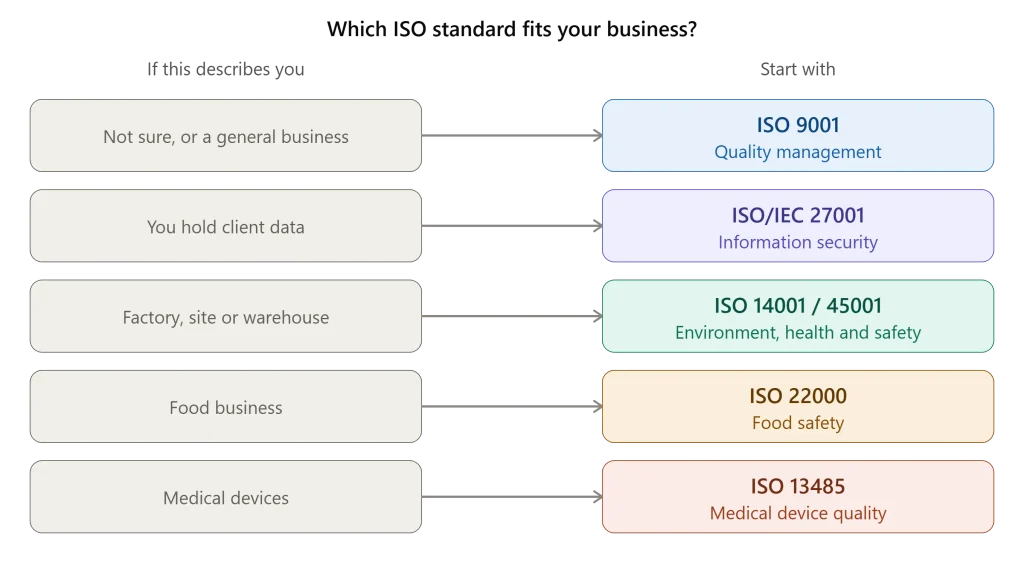
There’s no single winner, but there is a pattern.
ISO 9001: if you can’t decide, start here. It suits traders, agencies, service providers and manufacturers, and most buyers recognise it without needing an explanation. For most people asking about ISO Certification for Small Businesses, this is the answer.
ISO 27001: pick this if you hold client data. Think of a small software firm, a BPO or an accounting practice. Clients send security questionnaires, and this certificate answers most of them in one go.
ISO 14001 and 45001: these are for ground-level work such as factories, construction sites and warehouses. Big contractors often expect their vendors to have environmental and safety systems.
ISO 22000 and 13485: these cover food and medical devices. The market or the regulator usually picks the standard for you, so there’s less to decide.
Honestly, choosing the best option in ISO Certification for Small Businesses mostly comes down to one question: who is asking you for it?
Questions to ask before you choose
- Did a client or tender name a standard? Start with that one.
- Where is your biggest risk right now: complaints, data leaks, injuries?
- Does your industry have rules that point to one standard?
- How many hours can your team spare each week? Be realistic.
- Are you planning to export in the next year or two?
If you’re stuck between two, pick one and do it well. Adding a second later is easier than people expect, because ISO 9001, 14001 and 45001 share the same basic structure, so half your documents carry over. That’s a sensible way to approach ISO Certification for Small Businesses without burning out your team.
How the process works
- Decide which standard you need.
- Do a gap analysis: compare what you do today with what the standard asks.
- Write down your key processes in plain language.
- Train your staff and run the system for a couple of months to build records.
- Do an internal audit and a management review.
- Go through the Stage 1 and Stage 2 audits with the certification body.
- Expect yearly surveillance audits and recertification every three years.
How long it takes depends on how organised you are today. A tidy 20-person company may be ready in a few months. If nothing is documented yet, plan for longer, and don’t rush. The process for ISO Certification for Small Businesses looks simple on paper, but records need time to build up.
What will it cost?
There’s no fixed number, sadly. It depends on headcount, number of locations and how complex your work is. Typical items:
- Consultant fee (optional)
- Certification body audit fees
- Staff time
- Training or software, if you need it
Audit days are mostly worked out from employee count, so small firms pay less than big ones. Ask at least two accredited bodies for quotes and compare them. The full cost of ISO Certification for Small Businesses should be clear before you sign, and yes, ask about annual fees too, because they’re easy to miss.
Mistakes that come up again and again
- Downloading a template manual and pasting your company name on it. Auditors spot this fast.
- Handing the whole thing to one person. When they leave, the system leaves too.
- Picking a certifier because it’s cheap, not because it’s accredited.
- Skipping the internal audit.
- Going after three standards in one year.
Most of these happen when people treat ISO Certification for Small Businesses like a certificate hunt instead of a way to run the business.
Conclusion
For most small companies, ISO 9001 is the sensible first step. If you handle client data, look at ISO 27001 first. If safety or the environment is central to your work, go for 45001 or 14001.
Get the certificate, sure. But the real value of ISO Certification for Small Businesses shows up afterwards, when your team follows the processes on an ordinary Tuesday and not only in the week before the audit.
Not sure where to begin? A good consultant, such as the team at ISPL, can look at your business and tell you quickly which route to ISO Certification for Small Businesses fits you best.

admin
Part of the ISPL Cert team, helping organizations achieve ISO, CMMI and international certifications.