 admin
Table of Contents
Getting a CMMI rating takes several months of real effort from your team, and it doesn’t ship a single feature. So it’s reasonable for a founder to wonder what the company gets back.
The short version: better odds of winning contracts, and fewer problems while delivering them. Below are the benefits of CMMI Level 3 Certification for IT Companies in 2026, with the costs and the parts people usually skip over.
What Is CMMI Level 3?
CMMI stands for Capability Maturity Model Integration, and ISACA maintains it now. Companies are rated from Level 1 to Level 5, and Level 3 is called “Defined.” That means the whole company follows one documented way of planning, building, testing and tracking projects, instead of each team doing its own thing. The rating comes from an appraisal by an authorised lead appraiser, who checks real project records and interviews your staff. Once it passes, your result is published on the official CMMI registry for three years, and any client can look it up there.
Why Does CMMI Level 3 Certification for IT Companies Matter in 2026?
Open a vendor questionnaire from a US or European client and there’s a good chance a CMMI question sits somewhere in it. A buyer can’t see inside your office, so they look for things they can check quickly, and a published rating is one of the easiest. Large Indian enterprises and government departments have started asking for it too. For most firms, the biggest payoff of CMMI Level 3 Certification for IT Companies is plain eligibility. Some tenders throw out bids without a rating before anyone reads the price.
Top Benefits of CMMI Level 3 Certification for IT Companies
- Access to more tenders: Some RFPs reject any bid without a rating. Level 3 puts you back on the eligible list.
- Fewer defects reaching the client: Peer reviews and test plans become routine. More bugs get caught before release, when they’re cheaper to fix.
- Fewer missed deadlines: Plans get compared with actual effort every month, so delays show up while there’s still time to act.
- Quotes you can defend: Data from past projects shows how long similar work really took. Your estimates stop being a guess.
- Smoother growth: New teams copy a working method instead of inventing their own. Quality holds up better as headcount rises.
- Easier client conversations: You can point to a registry entry rather than explain your process from scratch every time.
What Changes Inside the Team
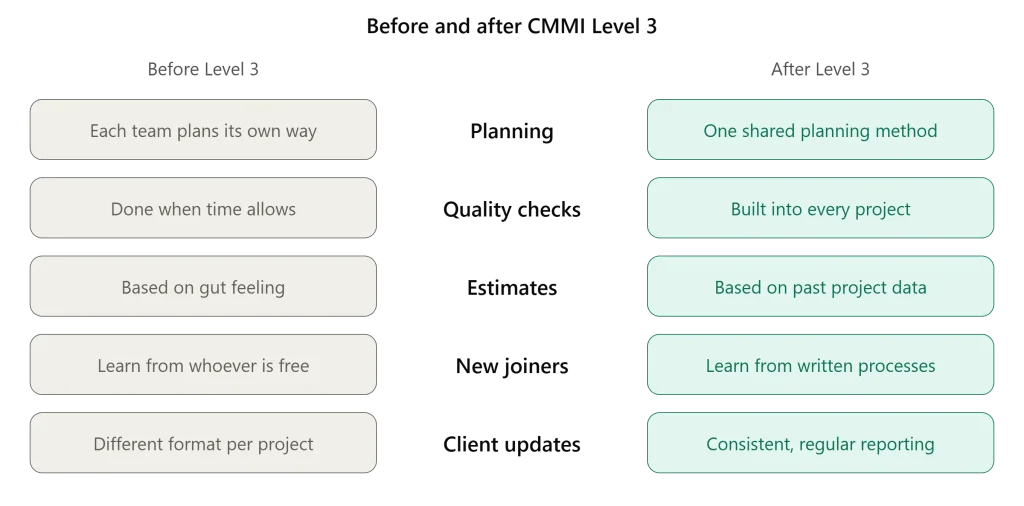
After CMMI Level 3 Certification for IT Companies, most teams notice the change in routine work first, long before any new contract arrives. Planning meetings look similar from one project to the next. Reviews happen because the process says so, not because someone had spare time. Managers stop rebuilding status reports from scratch.
| Area | Before Level 3 | After Level 3 |
| Project planning | Each team plans its own way | One shared planning method |
| Quality checks | Done when time allows | Built into every project |
| Estimates | Based on gut feeling | Based on past project data |
| New joiners | Learn from whoever is free | Learn from written processes |
| Client updates | Different format per project | Consistent, regular reporting |
Small Teams vs Bigger Companies
A large company often has a brand name that does half the convincing. A 40-person team doesn’t, and that’s where CMMI Level 3 Certification for IT Companies helps the most, because the rating speaks for you in rooms you aren’t in. It also forces good habits early, like written processes and tracked estimates, before sloppy ones settle in. Mid-sized firms tend to use it to land a first enterprise client. Bigger ones use it mainly to keep teams in different cities working in the same way.
Will It Get You More Contracts?
Not on its own. CMMI Level 3 Certification for IT Companies gets you onto the shortlist, and after that price, skills and references decide the deal like they always did. What changes is how many doors are open. Firms that sell to overseas clients often find that one or two contracts they couldn’t have bid on before cover most of the cost. For firms that sell only locally and nobody asks for a rating, the case is weaker, and ISO 9001 may do the job for now.
Cost and Timeline
Cost depends on company size, how many projects you put in scope, and how organised your processes already are. A narrow scope keeps the cost of CMMI Level 3 Certification for IT Companies down, because fewer people need training and fewer projects need evidence. These are rough, indicative figures, not a quote.
| Team Size | Typical Timeline | Estimated Total Cost (INR) |
| 10–50 people | 4–6 months | ₹8–10 lakh |
| 50–200 people | 6–9 months | ₹10–15 lakh |
| 200+ people | 9–12 months | ₹15–25 lakh+ |
The rating lasts three years, so keep a renewal appraisal in your plans.
Things to Know Before You Start
It only works if people use it: If the team copies templates and ignores them, the system fades in a few months. The appraisal won’t save you from that.
Results come slowly: Most firms see clear effects in the second or third year, not the first week.
It takes your team’s time: Training, writing processes and collecting evidence run next to normal project work. Plan the workload.
Leadership has to stay involved: When the founder or CEO attends the reviews, the effort sticks. When they step back, it usually drifts.
How to Get Started
- Fix the scope. Pick the teams and projects that go into the appraisal.
- Train your people. Keep sessions short and focused on the practices that apply.
- Define your processes. Write what you really do, not what looks good on paper.
- Run live projects. Use the processes for a few months and save the records.
- Do a mock appraisal, then the official one. Fix weak spots first.
How ISPL Can Help
At ISPL, we provide CMMI training and appraisal support to IT companies in India and abroad, along with ISO certifications like ISO 9001 and ISO/IEC 27001. We explain scope, timeline and fees upfront, so you can judge whether CMMI Level 3 Certification for IT Companies fits your plans. Visit isplcmmi.com and tell us about your team and your target date.
Final Words
The real return on CMMI Level 3 Certification for IT Companies is steadier delivery and a bigger pool of contracts you can bid for. It isn’t instant, and it needs your leadership to keep it alive. Start with a tight scope, write down how you actually work, and choose a partner who is clear about pricing.
1. What are the main benefits of CMMI Level 3 Certification for IT Companies?
CMMI Level 3 helps IT companies improve project management, maintain consistent software quality, reduce delivery risks, improve client confidence and qualify for business opportunities that require a recognised CMMI rating.
2. How does CMMI Level 3 help IT companies get more projects?
Many enterprise clients and government tenders prefer or require suppliers to have a CMMI rating. Achieving Level 3 can help IT companies meet these requirements and compete for larger domestic and international projects.
3. How long does it take to achieve CMMI Level 3?
Most IT companies take approximately 4–12 months, depending on team size, project complexity, existing processes and appraisal readiness.
4. What is the cost of CMMI Level 3 Certification in India?
The estimated cost can range from ₹4 lakh to ₹25 lakh or more. The actual cost depends on company size, appraisal scope, training requirements and the number of projects included.
5. Is CMMI Level 3 suitable for small IT companies?
Yes. Small IT companies can also pursue CMMI Level 3. It helps them establish structured processes, improve delivery consistency and demonstrate their process maturity to potential clients.
6. Is CMMI Level 3 better than ISO 9001 for IT companies?
Both serve different purposes. ISO 9001 focuses on quality management systems across an organisation, whereas CMMI Level 3 focuses on defined and consistently implemented processes. Some IT companies benefit from having both.
7. How long is a CMMI Level 3 rating valid?
A CMMI appraisal result is generally valid for three years. Organisations should plan for a new appraisal before the validity period expires.

admin
Part of the ISPL Cert team, helping organizations achieve ISO, CMMI and international certifications.