 Aditi Malik
Table of Contents
Teams preparing for their first CMMI Level 3 Appraisal usually ask us the same thing on the very first call: what will the appraiser actually do for those few days? Fair question. Nobody likes surprises when a client contract depends on the result.
Short answer, nobody is hunting for mistakes. A Lead Appraiser certified by the CMMI Institute sits with your people, reads what they produced and asks how the work really got done. That’s the whole job. Below is the full sequence, in the order it happens.
What the Appraiser Wants to See Before Anything Else
Level 3 is called “Defined”. Your company has one standard way of working, and projects adapt it with approval instead of improvising. Simple on paper. In practice this is where teams struggle, because three projects in the same office often run in three different ways.
So a CMMI Level 3 Appraisal tests consistency far more than paperwork. The method used is SCAMPI A, the only one that produces an official maturity rating.
From First Call to Published Rating: The 8 Stages
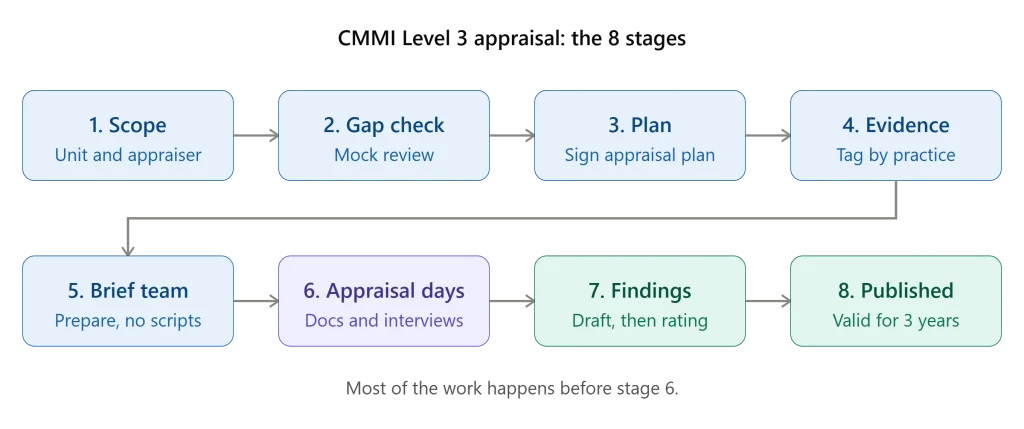
1. Decide what is being appraised. The organizational unit can be one delivery center or the entire company. Pick your Lead Appraiser at the same time. Talk to two or three of them. Experience in your industry counts for more than a big name.
2. Run a gap check before the real thing. A mock review against the model gives you a list of weak spots, and it’s usually longer than anyone hoped. Uncomfortable, yes. Also the most useful week of the whole project. Skip it and your first CMMI Level 3 Appraisal gets rough fast.
3. Sign the appraisal plan. It lists the scope, the selected projects, who will be interviewed, the dates and the target level. Choose the sample projects honestly: one large, one small, one older, one recent.
4. Collect your evidence. Project plans, review records, test reports, risk logs, training sheets. Tag each file with the practice it supports, so nobody searches through folders on appraisal day.
5. Brief your team. People should know what an interview feels like. Please don’t write scripts for them. Appraisers can hear a rehearsed answer from across the room.
6. Appraisal days. The team reviews documents, interviews project leads, developers, testers and managers, and holds feedback sessions to confirm what they heard. Every practice needs backing from at least two sources, normally a document plus a conversation. This is the core of the CMMI Level 3 Appraisal.
7. Findings and rating. You see the draft findings first, which is your chance to fix factual errors. If all the required practice areas are satisfied, the rating is Maturity Level 3.
8. Results go public. The Lead Appraiser submits the appraisal data to the CMMI Institute. After acceptance, your result appears in the Published Appraisal Results listing, and it stays valid for three years.
How Long Will It Take? A Realistic Timeline
Here is a rough timeline for a CMMI Level 3 Appraisal. Your own numbers will shift with company size and where your processes stand today.
| Phase | What Happens | Typical Time |
| Scoping and planning | Pick unit and Lead Appraiser, sign plan | 2 to 4 weeks |
| Gap check | Review against model, fix weak spots | 4 to 12 weeks |
| Evidence preparation | Collect and index artifacts | 3 to 6 weeks |
| On-site days | Document review and interviews | 4 to 7 days |
| Findings and rating | Draft findings, final rating | 1 to 2 days |
| Reporting | Submission and publication | 1 to 3 weeks |
Look at the on-site row again. It’s the shortest of all. Most of a CMMI Level 3 Appraisal is won or lost in the weeks before anyone arrives.
Questions You Will Hear in the Interview Room
In every CMMI Level 3 Appraisal, the appraisers circle back to the same kind of questions:
- “Show me your standard process for project planning.”
- “How did this project adapt it, and who approved that?”
- “What happened when the scope changed in month three?”
- “Who trained you on this process?”
- “Where do you record risks, and who looks at them?”
If your people can answer these with real project examples and no long pauses, you’re most of the way there.
Mistakes We See Again and Again
- Documents made the week before. The dates give them away.
- Too many sample projects. More projects means more evidence to manage, with no benefit.
- Perfect paperwork, silent team. Records can’t answer a question for you.
- A last-minute sprint. A CMMI Level 3 Appraisal confirms habits. It can’t create them overnight.
- Leadership nowhere in sight. Without a sponsor, process work is the first thing dropped when a deadline lands.
Small Habits That Save Weeks of Effort
Give the project an owner, a calendar and a weekly fifteen-minute check-in, like any other business project. People forget this one. A CMMI Level 3 Appraisal drifts when it belongs to everyone and no one.
Use evidence from the last six to twelve months of real work. Name one process champion per project, someone who knows where the files are and can answer the appraisal team quickly. Keep your process documents short, because a two-page procedure that people use beats a forty-page one that sits in a folder.
And in interviews, say what actually happens. Admitting a weak spot is fine. Improvement findings appear in almost every report.
Is Level 3 Worth It for Your Business?
Not always. If overseas or government buyers ask for it in tenders, then yes. If your teams have started drifting into their own ways of working, also yes. If you’re a ten-person company and no client has asked, it can wait. A CMMI Level 3 Appraisal takes time and attention, and both should go toward a real need.
After the Rating Arrives
The rating is valid for three years, but the habits behind it have to keep running. Review your processes every quarter, track a few useful numbers and begin renewal planning around the two-year mark. Many companies slip here. A CMMI Level 3 Appraisal certificate on the wall doesn’t keep your processes alive by itself.
Update your website, proposals and tender documents too. Clients do notice.
Get Hands-On Help From ISPL CMMI
ISPL CMMI works with companies across the whole route: understanding the model, closing gaps, preparing evidence and getting ready for the appraisal itself. If you’re planning a CMMI Level 3 Appraisal and want a practical roadmap instead of a pile of templates, visit isplcmmi.com or write to our team.
The Final Word: Plan, Prepare, Be Honest
Nothing about the appraisal is mysterious once you know the order. Plan it, prepare for it, show real work and answer honestly. Start with the gap check, because it tells you exactly how much time your CMMI Level 3 Appraisal will take.
1. What is a CMMI Level 3 Appraisal?
A CMMI Level 3 Appraisal is an evaluation of an organization’s processes to determine whether they are defined, documented, standardized and consistently followed across projects. It helps organizations demonstrate their process maturity and capability.
2. How long does a CMMI Level 3 Appraisal take?
The appraisal preparation may take 2 to 6 months, depending on the organization’s size, existing processes and readiness. The formal appraisal activities generally take around 4 to 7 days.
3. What happens if an organization does not meet all CMMI Level 3 requirements?
If the appraisal team identifies unmet requirements, the organization may not receive the targeted maturity rating. It should address the identified weaknesses and follow the applicable appraisal requirements before pursuing another formal appraisal.
4. What documents are required for a CMMI Level 3 Appraisal?
Common evidence includes project plans, quality assurance records, risk management logs, training records, testing reports, review documents, process guidelines and performance measurement records.
5. Who conducts a CMMI Level 3 Appraisal?
A formal CMMI appraisal is led by a qualified and authorized CMMI Lead Appraiser, supported by an appraisal team. The team reviews organizational evidence and interviews employees to evaluate process implementation.
6. What is the difference between CMMI Level 2 and Level 3?
CMMI Level 2 focuses on managing processes at the project level, while Level 3 focuses on establishing organization-wide standard processes that projects can tailor according to their requirements.
7. How long is a CMMI Level 3 rating valid?
A CMMI appraisal rating is generally valid for three years from the appraisal end date, subject to applicable CMMI program requirements.

Aditi Malik
Part of the ISPL Cert team, helping organizations achieve ISO, CMMI and international certifications.