 admin
Table of Contents
Small IT companies hear “CMMI rating required” more often than they expect. It shows up in a tender, a vendor form from a bank, or an email from a client abroad. And a ten-person team starts to wonder whether that’s even realistic for them.
It is. This guide explains the CMMI certification requirements for small IT companies in India in plain words: what you need to prepare, what you can skip, and how long it takes.
What Are the CMMI Certification Requirements for Small IT Companies?
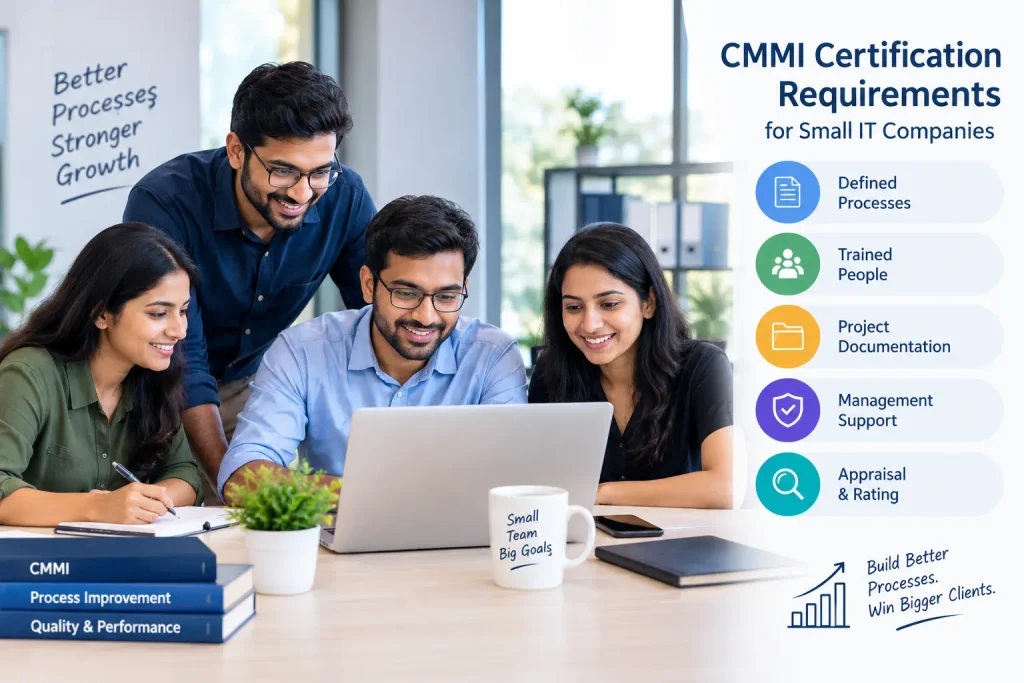
First, the good news. CMMI has no minimum company size. The CMMI certification requirements for small IT companies come from the same model that large firms follow. What changes is how much you write and how many people fall in scope. A short, honest system is perfectly fine.
One small note. Strictly speaking, CMMI is an appraisal and a rating, not a certificate. Everyone calls it certification, so we will too.
| Requirement | What It Means | For a Small Team |
| Defined scope | Which teams and projects go into the appraisal | One delivery unit is enough |
| Target level | Level 2 or Level 3 | Pick what your clients ask for |
| Documented processes | Written ways of planning, building and testing | Short, role-based documents |
| Project evidence | Real records from live projects | A few projects, tracked properly |
| Trained people | Staff know the process and their own role | Short sessions, not long courses |
| Management support | Leaders back the effort and give time | Founder or CEO involved |
| Appraisal | Review by an authorised lead appraiser | Official SCAMPI A appraisal |
Which Level Should You Aim For?
Choose the level before anything else, because the CMMI certification requirements for small IT companies grow with it. At Level 2 (Managed), your projects are planned and tracked. At Level 3 (Defined), the whole company follows one set of processes.
Many tenders that say “CMMI Level 3” mean exactly that. So check what your target clients write in their documents. If nobody asks for a specific level, Level 2 is a lighter first step, and you can move up later.
Documents and Evidence You Need
Most of the CMMI certification requirements for small IT companies come down to evidence. The appraiser wants to see that your team really works the way your documents say. Keep these ready:
Process documents: Short write-ups of how you plan, build, review and release. Two or three pages per process is usually plenty.
Project plans: Scope, schedule, effort and risks for each project in the appraisal. Update them when things change.
Requirement and change records: Proof that client requests were captured and changes were approved. Ticket history or email trails often work.
Review and testing records: Code reviews, test cases and bug reports. These show quality is checked before delivery.
Version control history: Your Git or similar repository, plus release notes. It shows how the code changed and who approved it.
Measurement data: Effort, defects and schedule numbers collected over time. Even simple spreadsheets count.
People and Management Requirements
Paperwork alone doesn’t pass an appraisal. The lead appraiser also interviews your team, and the answers have to match the documents. If a developer describes a different review process from the one you wrote, that gap shows up quickly.
Management support is the requirement small companies forget most. In a small firm, the founder or CEO usually has to sponsor the effort, join a few sessions and give people time to do the work. When leadership treats CMMI as a side task, the system fades within months. Among all the CMMI certification requirements for small IT companies, this one decides whether the rating survives past the appraisal day.
Steps to Meet the Requirements
Here is the order that works for most small teams.
- Fix the scope. Pick one delivery unit or a few projects, not the whole company.
- Choose the model view and level. Development or Services, Level 2 or 3.
- Train your team. Short sessions on the practice areas that apply to you.
- Write your processes. Keep them simple and true to how you actually work.
- Run live projects. Use the processes for a few months and save the evidence.
- Do a mock appraisal. Find the weak spots before the official one does.
- Go for the official appraisal. Your lead appraiser reviews everything, and the result is published on the official CMMI registry.
How Long Does It Take, and What Does It Cost?
Time and cost depend mostly on scope. Here is a rough guide for small teams.
| Team Size | Typical Timeline | Estimated Total Cost (INR) |
| 10–25 people | 4–5 months | ₹8–10 lakh |
| 25–50 people | 5–6 months | ₹10–12 lakh |
These are indicative figures, not a quote. A narrow scope keeps the bill lower, so meeting the CMMI certification requirements for small IT companies on one or two projects costs far less than putting everything in. Also remember the rating is valid for three years, so plan for renewal later.
Mistakes Small Teams Make
The most common one is copying a big company’s templates word for word. You end up with forty-page procedures that a ten-person team will never follow, and the appraiser spots that quickly. Keep documents short.
Another mistake is putting every project in scope. Two well-documented projects beat six messy ones. Some teams also start collecting evidence only a week before the appraisal, which never works, because the appraiser looks for records spread over months. And plenty of companies pick the lowest quote without checking what’s included, then pay again when they have to repeat the appraisal.
If your documents describe real work, the CMMI certification requirements for small IT companies feel much lighter than they look on paper.
How ISPL Can Help
At ISPL, we provide CMMI training and appraisal support to IT companies in India and abroad, along with ISO certifications like ISO 9001 and ISO/IEC 27001. We explain the scope, timeline and fees upfront, so a small team knows exactly where it stands. Visit isplcmmi.com and share your team size, projects and target date to get a clear quote.
Final Words
The CMMI certification requirements for small IT companies are lighter than most founders fear. Keep your scope tight, write only what your team will use, collect evidence from real projects, and get your leadership involved from the start. Do that, and the rating becomes a tool for winning bigger clients, not just a line on a tender form.
1. Can a small IT company get CMMI certification in India?
Yes. Small IT companies can achieve a CMMI rating in India or worldwide. There is no fixed minimum company size, aprox 15 members can implement and appraised. Even startups and companies with small development/Service teams can prepare for a CMMI appraisal.
2. What are the basic CMMI certification requirements for small IT companies?
The basic requirements include defined processes, project documentation, trained employees, management involvement, project records and evidence that the organization follows its processes.
3. Which CMMI level is best for a small IT company?
CMMI Level 2 is a practical starting point for companies looking to establish managed project processes. Level 3 is suitable for organizations that want standardized processes across their operations or need it for client requirements.
4. How many employees are required for CMMI certification?
There is no universal minimum employee requirement for CMMI. The appraisal scope, organizational structure, project teams and applicable model requirements determine the suitability of the organization. Even aprox 15 members are qeuired for implementation.
5. What documents are required for CMMI certification?
Common documents include project plans, requirement records, risk management records, review reports, testing records, configuration management records, performance measurements and process guidelines.
6. How long does it take for a small company to achieve CMMI certification?
A small IT company may take approximately 4–6 months to prepare, depending on its existing processes, appraisal scope, team size and target maturity level.
7. What is the cost of CMMI certification for small IT companies in India?
The estimated cost may range from ₹8 lakh to ₹10 lakh for small organizations. Actual costs depend on the appraisal scope, team size, training and appraisal arrangements.

admin
Part of the ISPL Cert team, helping organizations achieve ISO, CMMI and international certifications.