 admin
Table of Contents
A prospect is ready to sign with your startup, but their security team sends one condition first: share a recent VAPT report. You’ve never ordered one. The quotes you collect run from ₹20,000 to ₹3 lakh, and nobody explains why.
This post breaks down VAPT Testing Cost for Startups in India, what moves the number, and how to avoid paying for things you don’t need.
What Is VAPT?
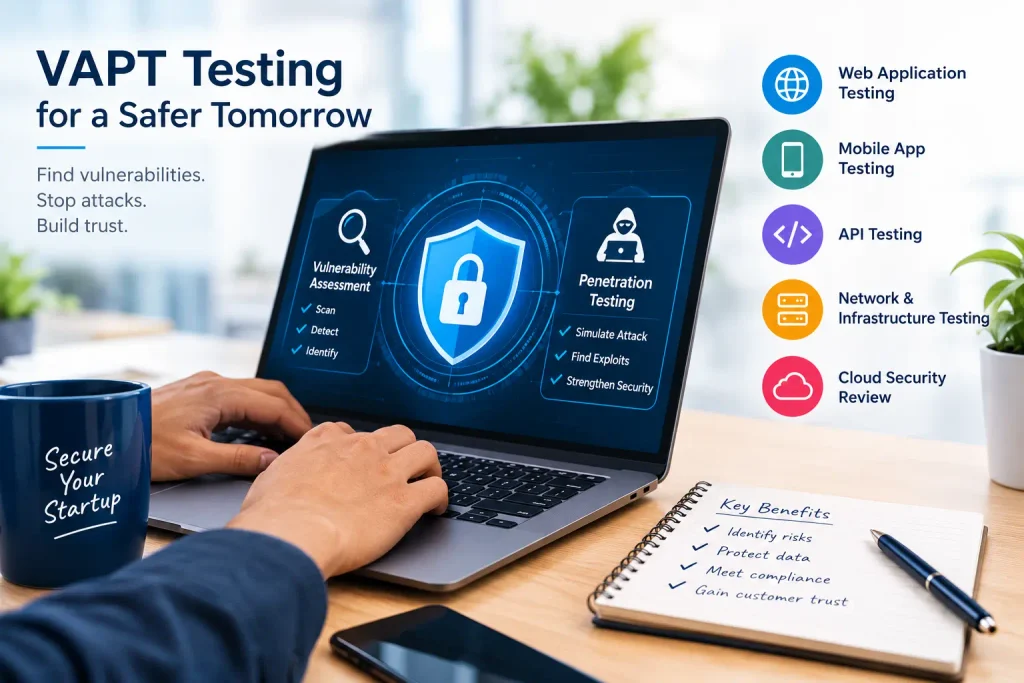
VAPT stands for Vulnerability Assessment and Penetration Testing, and it’s really two jobs. The assessment scans your app or network for known weak spots. The penetration test goes a step further. A tester actually tries to get in, using those weak spots, the way a real attacker would.
At the end you get a report with what was found, how serious each issue is, and how to fix it.
Startups order VAPT for different reasons. A client asked for it, an investor wants proof, an ISO/IEC 27001 audit expects it, or the founders just want to know before a big launch.
How Much Is VAPT Testing Cost for Startups in India?
Most early-stage startups pay somewhere between ₹25,000 and ₹2 lakh for one test. That’s a huge spread, but “VAPT” can mean a quick scan of one website or two weeks of manual work on a full product. Here’s roughly how it breaks down.
| Type of Test | Typical Range (INR) | Usual Time |
| Web application | ₹30,000–1.5 lakh | 1–2 weeks |
| Mobile app (Android or iOS) | ₹40,000–1.5 lakh | 1–2 weeks |
| API testing | ₹25,000–1 lakh | About 1 week |
| Network or infrastructure | ₹30,000–1.5 lakh | 1–2 weeks |
| Cloud security review | ₹50,000–2 lakh | 1–2 weeks |
Treat these as ballparks. Testing web, API and mobile together often brings the price per item down. Your real VAPT Testing Cost for Startups in India shows up only after you tell the provider what’s in scope.
What Decides the Price?
Two startups with similar-looking products can get very different quotes. Six things explain most of the gap in VAPT Testing Cost for Startups in India.
Scope size: Every app, API and IP address adds testing hours. More targets means more days on the clock.
Testing approach: In black box testing the tester starts blind, grey box gives partial access, and white box shares code or architecture. Deeper access costs more and finds more.
Manual or automated: A scanner-only report is cheap and shallow. A person testing by hand costs more, but catches logic flaws that scanners walk right past.
App complexity: Several user roles, payment flows and dozens of APIs mean more test cases. A simple site with one login is much quicker.
Compliance needs: Some clients insist on a CERT-In empanelled auditor or a fixed report format. That shrinks your options, and the price moves up.
Retests and deadlines: Free retesting isn’t always included. A three-day rush job also comes with a premium.
What Should a Good Quote Cover?
Before you compare any VAPT Testing Cost for Startups in India quote, check what’s actually inside it. A proper one names the targets, the type of testing, how many retests are included, the report format and the timeline.
Ask for a sample report as well. If it looks like raw scanner output with a logo stuck on top, that explains the low price. And if your client rejects the report, you end up paying twice.
Costs Startups Forget
The invoice isn’t the full bill. Your developers will spend days fixing findings, and some fixes touch core code. Retests may be charged separately. Then there’s the shelf life. Most clients want a report from the last six to twelve months, and you should test again after any major release.
So treat VAPT Testing Cost for Startups in India as a yearly line item, not a one-off.
How to Spend Less
You can’t make the bill vanish, but you can trim it. Start with scope. Test the product your client actually cares about, not every internal tool you own.
Fix the obvious stuff first: default passwords, open ports, missing updates. That way the tester’s hours go on harder problems. Bundle web, API and mobile into one engagement where possible. Get the retest written into the quote. And think twice about the cheapest offer, because a rushed scan might pass one questionnaire and fall apart in the next client review.
Is VAPT Worth It for an Early-Stage Startup?
Mostly, yes. One lost enterprise deal costs more than a typical test. A breach costs far more: customer trust, legal trouble, weeks of cleanup. Next to that, VAPT Testing Cost for Startups in India is small.
It also saves time. A recent report answers many client security questions in one go, so sales stops waiting on engineers to fill in forms.
How Does a VAPT Engagement Work?
Knowing the steps helps you read any proposal with a clearer head.
1. Scoping call: You share the apps, URLs and environments to be tested.
2. Testing: Scans and manual attacks run, usually on a staging setup.
3. Report: You get findings ranked by severity, with fix suggestions.
4. Fixes: Your developers close the issues, critical ones first.
5. Retest: The tester checks the fixes and issues a final report.
How ISPL Can Help
At ISPL, we work with startups and IT companies on ISO/IEC 27001 training and audit support, where a VAPT report often counts as evidence. We also cover ISO 9001, ISO/IEC 20000-1 and CMMI. We can explain what your clients and auditors expect, so your VAPT Testing Cost for Startups in India goes toward a report that actually gets accepted. Visit isplcmmi.com and tell us what you need.
Final Words
VAPT Testing Cost for Startups in India depends mostly on scope, depth and how tidy your setup is. Keep the scope tight, fix the easy problems before testing, and get everything in writing before you sign. One good report can keep client conversations moving for a full year.
1. What is the VAPT Testing Cost for Startups in India?
The VAPT Testing Cost for Startups in India typically ranges from ₹25,000 to ₹2 lakh, depending on the scope, application complexity, testing depth, and service provider. Larger or more complex projects may cost more.
2. How much does website VAPT testing cost in India?
Website VAPT testing generally costs around ₹30,000 to ₹1.5 lakh. The final price depends on the number of pages, user roles, application features, APIs, and manual testing requirements.
3. How much does mobile app VAPT testing cost?
Mobile application VAPT testing can cost approximately ₹40,000 to ₹1.5 lakh for an Android or iOS application. Testing both platforms or including backend APIs may increase the overall cost.
4. How long does VAPT testing take for a startup?
A typical VAPT engagement takes around one to two weeks. Smaller applications may require less time, while complex applications, cloud environments, and multiple APIs may need additional testing time.
5. What factors affect VAPT Testing Cost for Startups in India?
The main factors include the number of applications and APIs, infrastructure size, manual testing depth, application complexity, compliance requirements, reporting needs, retesting, and delivery deadlines.
6. Is VAPT mandatory for startups in India?
VAPT is not universally mandatory for every startup. However, it may be required by enterprise clients, contracts, regulatory obligations, or specific compliance requirements. Startups should check the requirements applicable to their industry and customers.
7. Is automated VAPT enough for a startup?
Automated scanning can identify many known vulnerabilities, but it may miss business logic flaws, access-control weaknesses, and complex attack paths. Combining automated tools with manual penetration testing generally provides more comprehensive coverage.

admin
Part of the ISPL Cert team, helping organizations achieve ISO, CMMI and international certifications.