 admin
admin
Table of Contents
Let me guess how you got here. A customer sent over a vendor form with an ISO box on it, or a tender you wanted had a clause you couldn’t tick. Annoying, yes. Also very common. And the next step is usually a late-night search for ISO Certification in India, because the standard itself reads like it was written for lawyers.
This post covers what ISO is, how the certification process runs, and five firms I’d shortlist for 2026. The first one is mine, so I’ll be upfront about that.
What ISO actually is
ISO is the International Organization for Standardization. It publishes standards, which are basically agreed rulebooks for how organisations should run things. ISO 9001 is quality. ISO 27001 is information security. 14001 is environment, 45001 is safety at work, 22000 is food safety. The newest one, ISO/IEC 42001, is for companies building or using AI.
A rulebook on its own gets you nothing. You put a system in place, run it for a while, and an accredited body audits it. Pass, and you get the certificate. Fail, and you fix the gaps and go again.
Why Is It Important?
People assume the certificate is the prize. It isn’t, really. Sure, foreign buyers know what it means, and some tenders won’t even open your bid without it. The real value is quieter. Your processes stop living in one senior person’s head. Errors surface sooner. And because audits come back every year, the system doesn’t slowly rot.
What Happens When You Skip the Audit/ Certification
Technically, yes. It tends to go badly. A team writes forty pages of procedures describing how work should happen on paper, then the auditor walks the shop floor and sees something else entirely. Back to square one. Decent ISO Certification in India avoid this by starting with how you really work, not with a template.
Certification Process
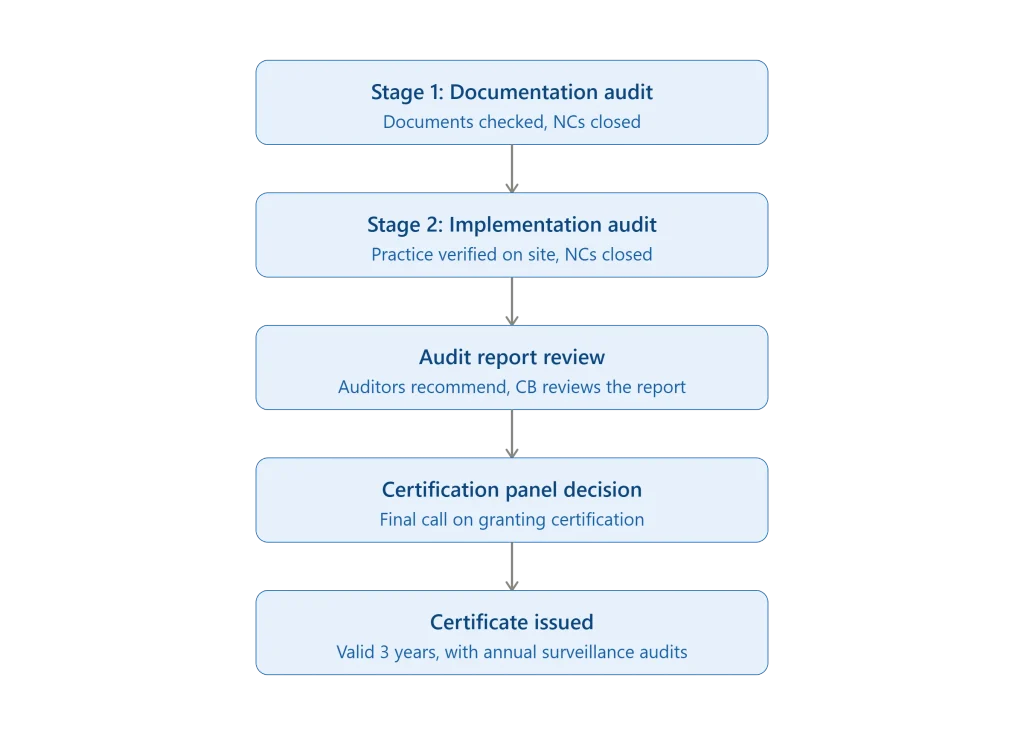
The certification process is fairly standard, regardless of which certification body you choose.
Stage 1: Documentation Audit (Document Verification)
- Review and verify the required documentation.
- Identify any Non-Conformities (NCs) or observations.
- Address and close all identified NCs and observations.
Stage 2: Implementation Audit (Implementation Verification)
- Verify the effective implementation of the documented systems and processes.
- Identify any NCs or observations during the audit.
- Take corrective actions and close all identified NCs and observations.
Certification Decision and Issuance
Once both audit stages are successfully completed, the auditors verify the closure of all NCs and observations, recommend certification, and submit the audit report to the Certification Body (CB) for review.
Following the review of the audit report, the Certification Panel makes the final decision on whether to grant certification.
Upon approval, the certificate is issued to the client and remains valid for three years, subject to successful completion of annual surveillance audits and compliance with the applicable certification requirements.
Mistakes That Keep Coming Up When Choosing an ISO Certification Body
- Choosing Based on Price Alone – Going with the cheapest quote without checking the certification body’s credibility, accreditation, or competence.
- Not Verifying Accreditation – Failing to confirm whether the certification body is accredited by a recognized accreditation body for the relevant ISO standard and industry scope. Not uploading database on IAF Portal.
- Confusing Accreditation with Certification – Assuming that every organization issuing ISO certificates is accredited or that every certificate carries the same level of recognition.
- Falling for Unrealistic Promises – Trusting providers who promise guaranteed certification, no audits, or certificates within an unreasonably short timeframe.
- Ignoring Industry Experience – Choosing a certification body without checking its experience in your industry, business activities, and applicable scope.
- Overlooking the Audit Process – Not understanding the audit stages, documentation review, implementation verification, and process for closing non-conformities (NCs) and observations.
- Ignoring Post-Certification Requirements – Forgetting that certification typically involves annual surveillance audits and a recertification audit at the end of the certification cycle.
- Not Checking Certificate Recognition – Failing to verify whether customers, tender authorities, regulators, or business partners will accept the certificate.
- Overlooking Hidden Costs – Not clarifying audit fees, travel expenses, surveillance charges, recertification costs, and other applicable fees in advance.
- Making Decisions Without Comparing Options – Not comparing the certification body’s accreditation status, competence, reputation, audit approach, and overall cost before making a decision.
Choosing the right ISO certification body is not just about getting a certificate. It is about ensuring that your certification is credible, recognized, and appropriate for your business requirements.
About ISPL/Why us
ISPL Cert (Intercontinental Systemcert Pvt Ltd, Delhi)
ISPL Cert works out of Janakpuri, New Delhi. It has been at this for 25+ years, has worked with clients in 50+ countries and has delivered 10,000+ certifications. The thing I’d point at first is breadth. Among ISO Certification in India, it’s unusual to find one team that handles ISO 9001, 14001, 45001, 22000, 20000-1, 27001, 22301, 50001 and 42001, plus CMMI, VAPT and SOC reporting. If you’ll need more than one certificate over the next couple of years, that saves you from juggling several vendors.
The method is four steps: Planning, Audit and Certification, then continual Surveillance Audits. No mystery. Clients come from IT, manufacturing, construction, healthcare, food, education and finance, and the team is on the phone from 8 AM to 8 PM. It also sticks around after the certificate is issued, which plenty of ISO Certification in India don’t bother with.
Need ISO Certification in India who actually answer calls? Go to isplcmmi.com, email info@isplcert.com, or ring +91 99904 77631.

admin
Part of the ISPL Cert team, helping organizations achieve ISO, CMMI and international certifications.