 admin
Table of Contents
If you’ve ever read a tender document, you’ve seen the line: “Bidders must hold a valid ISO certificate.” Overseas buyers ask for it too, and so do big companies that want to vet a supplier before signing. Plenty of business owners nod along without knowing exactly what it means.
So, what is ISO certification, and is it worth the effort? This guide explains it in plain words, covers the main types, lists the benefits, and walks through the steps to get certified in India.
What Is ISO Certification?
ISO stands for the International Organization for Standardization, a body based in Geneva that has published standards since 1947. A standard is an agreed way of doing something well. When an independent auditor checks your company against one of those standards and confirms you meet it, you get certified.
So what is ISO certification in daily terms? It’s a certificate, usually valid for three years, that says your processes are written down, followed by your people and reviewed on a regular basis. It doesn’t say your product is the best. It says you run your business in a controlled, consistent way.
One thing people miss: ISO itself doesn’t hand out certificates. Independent certification bodies do, and in India the better ones are accredited by NABCB. Always check accreditation first. Otherwise the client who asked for the certificate may refuse to accept it.
Popular Types of ISO Certification
There are thousands of ISO standards, but only a handful matter for most businesses. Here are the ones Indian companies ask about most.
| Standard | Focus | Best Suited To |
| ISO 9001 | Quality management | Almost any business |
| ISO 14001 | Environmental management | Manufacturers, construction |
| ISO 45001 | Workplace health and safety | Factories, project sites |
| ISO/IEC 27001 | Information security | IT firms, BPOs, SaaS companies |
| ISO 22000 | Food safety | Food makers, caterers |
| ISO 13485 | Medical device quality | Device manufacturers |
| ISO/IEC 20000-1 | IT service management | IT service providers |
| ISO 22301 | Business continuity | Banks, large service firms |
Most companies start with ISO 9001, and IT firms often add ISO 27001 a little later. The answer to what is ISO certification for your company depends on which of these you choose.
Benefits of ISO Certification
When owners ask what is ISO certification actually worth, these are the benefits they mention most often.
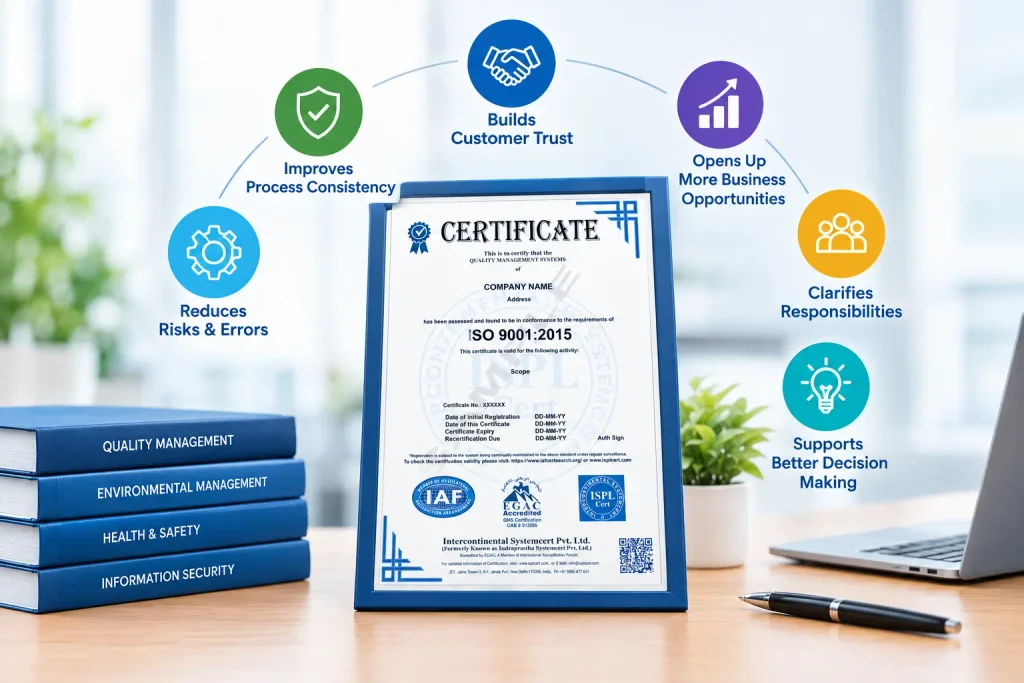
- More tenders and clients: Many government and corporate tenders ask for it. Without a certificate you may not even be allowed to bid.
- Fewer mistakes: Written processes mean a job gets done the same way every time. Rework and complaints usually fall.
- Customer trust: A third-party audit carries more weight than your own claims. Buyers feel safer signing with you.
- Clear responsibilities: Everybody knows who owns what. The “I thought you were doing it” conversations get rarer.
- Better decisions: Regular reviews put real numbers in front of management, so choices rest on data and not on gut feeling.
Who Needs ISO Certification?
For most businesses, ISO certification is voluntary. No law forces a shop or a small agency to get one. But “voluntary” stops being true when a client or a tender says otherwise, and that happens often.
Manufacturers, exporters, construction firms, IT companies and healthcare suppliers see the demand most. Even a ten-person company can benefit, because a short, simple system is easier to maintain than a big one. If you’re asking what is ISO certification going to change for a small firm, the usual answer is fewer messy handovers and a better chance with larger customers.
How to Get ISO Certified in India
Once you know what is ISO certification, the process itself is fairly straightforward. These are the steps.
- Pick the standard that matches your work and what your clients ask for.
- Fix the scope: which products, teams and locations will be covered.
- Train your team so they understand the requirements and their own role.
- Write and apply your processes. Keep them short and true to how you really work.
- Run an internal audit and a management review to catch problems early.
- Go through the certification audit, done in two stages by an accredited body.
- Receive the certificate and prepare for yearly surveillance audits.
Here is a rough idea of how long each stage takes for a small or mid-sized company.
| Stage | What Happens | Rough Time |
| Preparation | Training, scope, documents | 1–3 months |
| Running the system | Records build up from daily work | 1–2 months |
| Internal audit and review | You check yourself | 1–2 weeks |
| Stage 1 audit | Auditor reviews your documents | 1–2 days |
| Stage 2 audit | Auditor checks the system on site | 1–5 days |
| Certificate | Issued after findings are closed | 2–4 weeks |
These are indicative figures. Your own timeline depends on company size, number of sites and how organised you already are.
How Long Does It Take and What Does It Cost?
Small companies often finish in two to four months. Larger ones with several locations need longer. Cost depends on the standard, your headcount and the scope, so there’s no single price.
Before you ask what is ISO certification going to cost, fix your scope, because that drives the quote more than anything else. Also remember the certificate isn’t a one-time purchase. You’ll have a surveillance audit every year and a recertification audit after three years. Ask for all of this in writing before you start.
Mistakes That Make It Harder
Knowing what is ISO certification means helps you avoid the usual traps. The most common one is copying a template word for word, which leaves you with procedures nobody follows. Another is putting the whole company in scope when the client only needs one unit certified. Some companies pick an unaccredited body because the price looks low, then find the certificate isn’t accepted. And many treat it as one-time paperwork, so the system quietly dies the week after the audit.
If your documents describe how you really work, the audit is far less stressful.
How ISPL Can Help
At ISPL, we provide training and audit support for ISO 9001, ISO 14001, ISO 45001, ISO/IEC 27001, ISO 22000, ISO/IEC 20000-1, ISO 22301, ISO/IEC 42001 and CMMI to companies in India and abroad. If you’re still wondering what is ISO certification right for your business, our team can help you choose the standard, understand the steps and get a clear quote. Visit isplcmmi.com and tell us about your company and target date.
Final Words
By now you know what is ISO certification is, the main types, and the path to get one. Pick the standard your clients really ask for, keep your documents honest and short, and choose an accredited body. Do that, and the certificate stops being a piece of paper and starts bringing in work.
1. What is ISO certification?
ISO certification is an independent confirmation that an organization’s management system meets the requirements of a specific ISO standard. It helps businesses improve processes, maintain consistency, and build customer confidence.
2. What are the different types of ISO certification?
Popular types of ISO certification include ISO 9001 for quality management, ISO 14001 for environmental management, ISO 45001 for occupational health and safety, ISO 27001 for information security, and ISO 22000 for food safety.
3. Is ISO certification mandatory in India?
ISO certification is generally voluntary in India. However, it may be required by government tenders, corporate customers, contracts, or specific industry requirements.
4. How can a company get ISO certification in India?
A company can get ISO certification by selecting the appropriate standard, defining its scope, implementing the required management system, conducting internal audits, and completing an external certification audit through a suitable certification body.
5. How long does it take to get ISO certified?
The timeline depends on the company’s size, selected standard, and readiness. Small businesses may complete the process in approximately two to four months, although some organizations may require more time.
6. What is the cost of ISO certification in India?
The cost depends on the ISO standard, number of employees, business locations, audit duration, and certification body’s fees. Businesses should request a detailed quotation based on their requirements.
7. How long is an ISO certificate valid?
Many management system certificates follow a three-year certification cycle, subject to successful surveillance audits, continued compliance, and applicable certification rules.

admin
Part of the ISPL Cert team, helping organizations achieve ISO, CMMI and international certifications.