 admin
admin
Table of Contents
Here’s how it usually goes. A company decides to get ISO 9001, somebody downloads a sample quality manual from the internet, and within a month the shared drive has forty files with names like “Final_v3_new.” Then the audit date comes close and nobody can say which of those files the auditor will actually look at.
It doesn’t have to be this messy. Below is a plain list of the Documents Required for ISO 9001 Certification, who should look after each one, and what you can safely ignore. Read it once, then use it as a checklist.
What Counts as “Documented Information”?
ISO 9001 uses that phrase and everybody flinches. Honestly, it’s just two buckets. The first is stuff you write and keep updated, like your quality policy. The second is proof, like a training sheet with signatures, a calibration certificate or the minutes of a meeting.
The old 2008 version wanted six written procedures. The 2015 version dropped that rule. Plenty of people heard “less paperwork” and jumped to “no paperwork”, which is a mistake. The auditor still has to see that your system exists and that people actually use it.
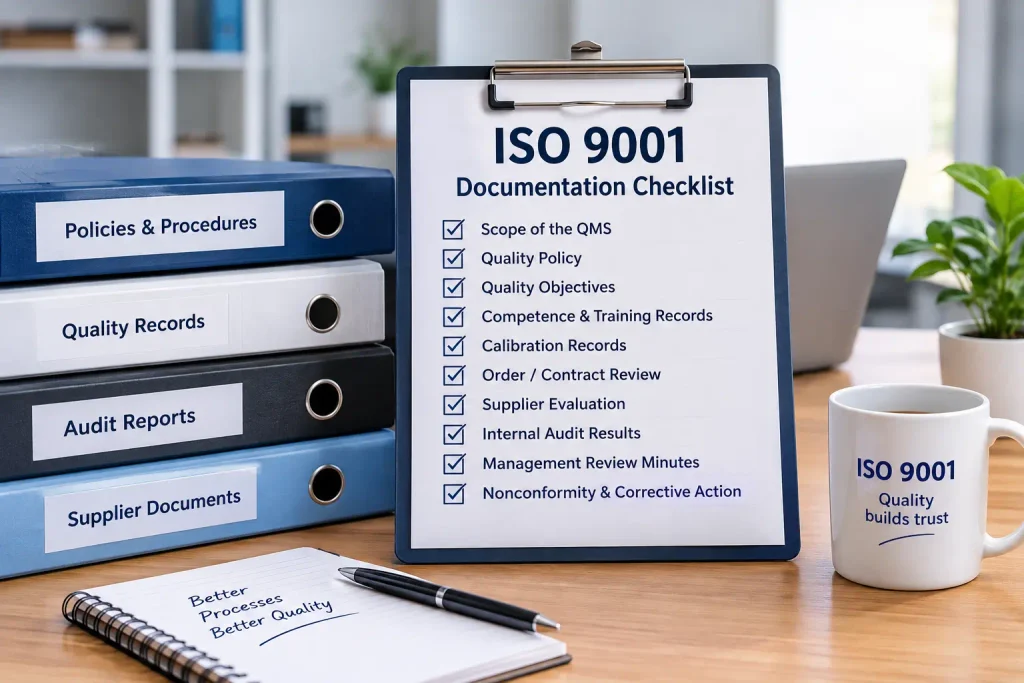
Documents Required for ISO 9001 Certification: The Short List
| Document / Record | Clause | What It Proves |
| Scope of the QMS | 4.3 | What your system covers |
| Quality policy | 5.2 | Where management is heading |
| Quality objectives | 6.2 | The targets you track |
| Competence and training records | 7.2 | Staff can do their jobs |
| Calibration records | 7.1.5 | Your measuring tools are accurate |
| Order or contract review | 8.2.3 | You can deliver what you promised |
| Supplier evaluation | 8.4 | Vendors are checked |
| Internal audit results | 9.2 | You check yourself |
| Management review minutes | 9.3 | Leaders are involved |
| Nonconformity and corrective action | 10.2 | Problems get fixed |
Some rows depend on your work. No design activity means no design records, and nobody will ask for them.
Who Should Own Each One
| Document | Usually Owned By | Review |
| Quality policy | Top management | Yearly |
| Quality objectives | Department heads | Every quarter |
| Training records | HR | After each session |
| Calibration records | QC or production head | When due |
| Supplier evaluation | Purchase team | Yearly |
| Internal audit report | Quality manager | At least yearly |
| Management review minutes | Top management | At least yearly |
| Corrective action records | Process owner | When an issue comes up |
Tweak it for your own setup. In a small company the quality manager ends up with half of these, and that’s fine.
Write These Three First
Scope, policy, objectives. Every other item among the Documents Required for ISO 9001 Certification points back to them, so do them before anything else.
Scope is a few lines on which products, sites and processes you cover. Skipping something? Say why. The policy should fit on one page. Try this: ask a machine operator to explain it without looking. If he can’t, rewrite it. Objectives need numbers. “Improve quality” means nothing. “Customer returns under 2% a month” means something.
Records: What the Auditor Opens First
Nobody gets excited about a manual. Records are another story. Of all the Documents Required for ISO 9001 Certification, these are the ones auditors ask for, and they want last month’s proof, not a polished promise.
Have these ready:
- Training and competence records
- Calibration certificates (an expired sticker on a gauge is a very common finding)
- Order or contract review
- Supplier approval and performance
- Inspection and traceability records
- Complaints, plus what you did about them
- Internal audit plan and report
- Management review minutes
Date and sign every one. A form without either proves very little.
Optional Paperwork
Process maps, work instructions, job descriptions, a risk register and a quality manual are all optional. A few are worth it, especially when a new joiner has to learn a job fast.
Just don’t go overboard. Every extra file on your list of Documents Required for ISO 9001 Certification is one more thing to update and explain. A 25-person packaging unit needs a handful of work instructions, not a binder.
What Happens in the Audit
There are two visits.
Stage 1 is a readiness check. The auditor asks about your scope, policy, objectives, processes, legal requirements and risks. They’ll also want to know whether you’ve done an internal audit and a management review, or at least planned them.
Stage 2 is the real thing. Now they look at records from the last few months, pull a few training and supplier files at random, check that corrective actions were closed, and chat with your staff. Suppose a supervisor describes a process one way and your document says another. That gap shows up fast. It’s the moment your Documents Required for ISO 9001 Certification either hold up or they don’t.
Getting Ready, in Order
You’ll prepare the Documents Required for ISO 9001 Certification faster if you follow a sequence:
- List your main processes and give each one an owner.
- Match each process to the clause it covers.
- Write only what’s needed, in plain words.
- Set up document control: version numbers, an approver, one storage place.
- Run the system for a few weeks so real records build up.
- Do an internal audit and a management review before the certification audit.
Don’t cram this into a weekend. It never works.
Where Companies Slip Up
Most findings about the Documents Required for ISO 9001 Certification come from the same handful of habits. A template gets copied without a single change. Procedures describe things nobody does. Two versions of a form float around because nobody controls them. Records go unsigned, the management review exists only on paper, and the key files sit on one person’s laptop.
The auditor will spot a mismatch between paperwork and reality within the first hour. They do this every week.
How ISPL Can Help
At ISPL we offer ISO 9001 training and audit support to companies in India and abroad, along with ISO 14001, ISO 45001, ISO/IEC 27001, ISO/IEC 20000-1 and CMMI. Not sure which Documents Required for ISO 9001 Certification apply to your kind of business? Visit isplcmmi.com and talk to our team.
Final Words
Here’s the thing: the Documents Required for ISO 9001 Certification aren’t a mountain. Scope, policy, objectives. Write those first. After that, just keep proper records of what your team already does, with dates and signatures. Got a file nobody has opened in a year? Delete it. Do this much and the auditor’s visit stops feeling like a test. It’s more like showing someone around your workplace.
1. What documents are required for ISO 9001 certification?
The main documents required for ISO 9001 certification include the QMS scope, quality policy, quality objectives, competence and training records, calibration records where applicable, supplier evaluation records, internal audit results, management review records, and corrective action records.
2. Is a Quality Manual mandatory for ISO 9001:2015?
No. ISO 9001:2015 does not specifically require organizations to maintain a quality manual. However, a quality manual can still be useful for explaining the organization’s Quality Management System, processes, scope, and responsibilities.
3. Are all ISO 9001 documents mandatory for every company?
No. The required documented information depends on the organization’s activities, size, processes, products, and risks. For example, calibration records may not apply if an organization does not use monitoring or measuring equipment requiring calibration.
4. What records do ISO 9001 auditors usually check?
Auditors may review training and competence records, supplier evaluations, customer complaints, order or contract reviews, inspection records, internal audit reports, management review minutes, and nonconformity and corrective action records.
5. How long should ISO 9001 records be kept?
Auditors may review training and competence records, supplier evaluations, customer complaints, order or contract reviews, inspection records, internal audit reports, management review minutes, and nonconformity and corrective action records.
6. Are ISO 9001 procedures mandatory?
Not every traditional procedure is mandatory under ISO 9001:2015. Organizations need to maintain documented information required by the standard and any additional information necessary to operate their processes effectively.
7. Do small businesses need the same ISO 9001 documentation as large companies?
No. ISO 9001 documentation should be appropriate to the organization’s size, complexity, processes, and risks. A small business can generally maintain a much simpler documentation system than a large organization.

admin
Part of the ISPL Cert team, helping organizations achieve ISO, CMMI and international certifications.