
VAPT – Vulnerability Assessment & Penetration Testing
Doesn’t matter if you’re a 20-person startup or a large enterprise with offices across the country — if you run an application, hold customer data, or have a network connected to the internet, someone out there is probably already poking at it. Attackers don’t check your revenue before they look for a way in. Our VAPT services exist to find that way in first, before they do.
Table of Contents
What VAPT Actually Means
People use VAPT as one word, but it’s really two things stitched together. A vulnerability assessment scans your systems and flags known weaknesses — outdated software, weak configurations, access controls that were set up in a hurry and never revisited. Penetration testing picks up from there. Our team actually tries to break in, using the same techniques a real attacker would, in a way that’s controlled and fully authorized, just to see how far a breach could actually travel.
Put both together and VAPT gives you more than a list of theoretical risks. You get proof of what’s genuinely exploitable, and what the real damage would look like if someone got through.
What Our VAPT Services Cover
We structure our VAPT services around where businesses actually get hit.
Application testing — web apps, mobile apps, APIs. We look for injection flaws, broken authentication, data that isn’t handled carefully, and the logic errors that automated scanners tend to walk right past.
Network testing — internal and external infrastructure, checking for open ports, loose firewall rules, outdated protocols, and how easily an attacker could move sideways once inside.
Cloud security review — AWS, Azure, GCP environments, looking at misconfigured storage buckets, permissions that are wider than they need to be, and exposed services nobody remembers setting up.
Infrastructure testing — servers, endpoints, and the systems around them, checked for missing patches and configuration gaps that build up quietly over time.
Why This Actually Matters
One unpatched server or one misconfigured setting can turn into a data breach, downtime, or a regulatory headache pretty fast. Regular VAPT services keep you a step ahead, in a few practical ways.
It catches problems while they’re still just problems, not incidents. It also lines up with what most compliance frameworks already expect — CERT-In guidelines, SOC 2, PCI DSS, ISO/IEC 27001 all assume some form of regular testing. Clients notice too. Being able to hand over a recent VAPT report tells a finance or healthcare client you’ve actually checked your own house. And frankly, the cost of a VAPT engagement is nearly always smaller than cleaning up after a real breach. Instead of trying to fix everything overnight, you get a ranked list — what’s serious, what can wait, so your team spends effort where it counts.
Who This Is Really For
Our VAPT services make sense for a fairly wide range of organizations:
- IT and software companies handling client data or running customer-facing applications
- E-commerce and fintech businesses moving money or sensitive financial details
- Healthcare organizations holding patient records
- Anyone preparing for ISO/IEC 27001, SOC 2, or PCI DSS
- Businesses that recently expanded infrastructure, shipped a new app, or moved to the cloud
- Companies whose clients, regulators, or cyber insurance provider now expect proof of regular testing
If your business touches sensitive data or has an online presence that actually matters, VAPT is worth putting on the calendar every year rather than only after something goes wrong.
How We Run the Process
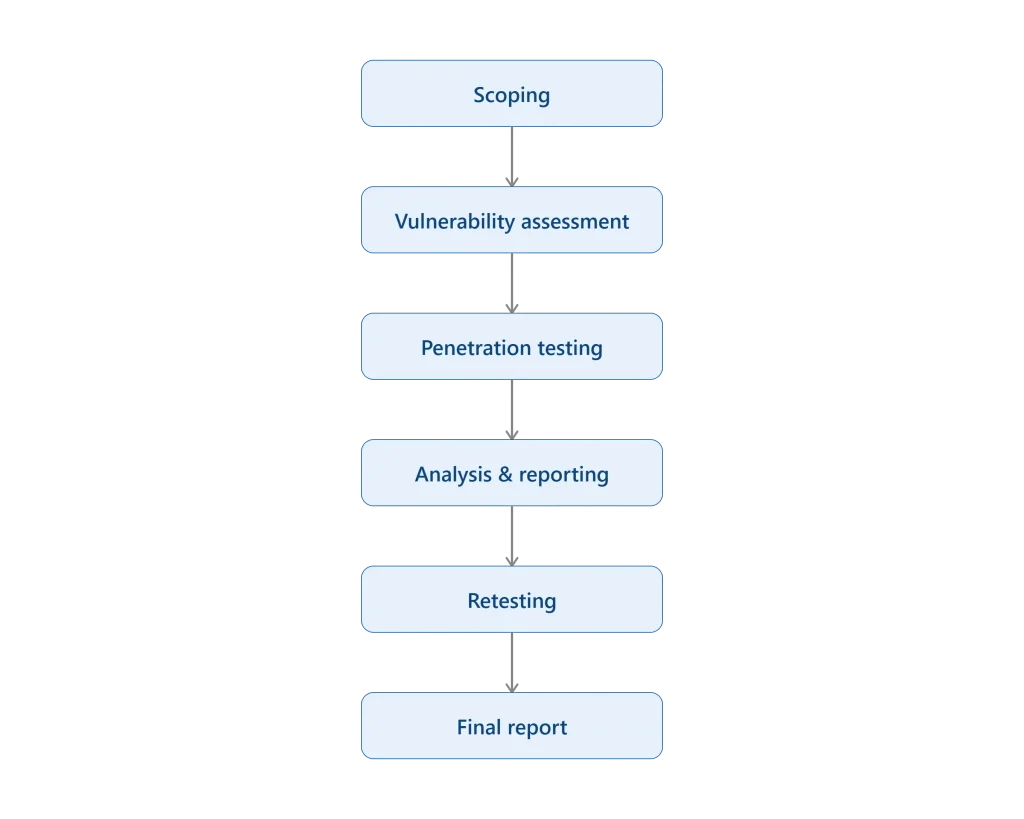
01 — Scoping. We agree on what’s in scope — which applications, network segments, cloud environments, or systems — and set clear rules of engagement.
02 — Vulnerability assessment. A mix of automated scanning and manual checks to surface known vulnerabilities and misconfigurations across that scope.
03 — Penetration testing. Our team attempts to exploit what we’ve found, the way a real attacker would, to see what’s genuinely at risk.
04 — Analysis and reporting. Every finding gets a severity rating, technical detail, and clear next steps — not just raw scanner output dumped into a PDF.
05 — Retesting. Once fixes go in, we come back and confirm the vulnerabilities are actually closed, not just marked as done.
06 — Final report. You get a report you can share with clients, auditors, or compliance bodies, plus a certificate of testing where it’s needed.
Why ISPL
ISPL is an EGAC-accredited certification body with a long track record across ISO certification, CMMI appraisals, and cybersecurity work. Our VAPT services come from people who understand both the technical side of breaking into systems and the compliance frameworks—CERT-In, SOC 2, PCI DSS, ISO/IEC 27001 — that usually sit behind the request in the first place.
What that means in practice for our VAPT services: real testers doing the work, not a scanner with our logo on the report. Testing mapped to the frameworks you actually need to satisfy. Reports your technical team can genuinely act on. Retesting included, so you know fixes actually held. And coverage across application, network, cloud, and infrastructure, so you’re not piecing this together from three different vendors.
Get Started
If it’s been a while since anyone checked your systems properly, or you’ve got a compliance audit coming up that wants proof of testing, this is worth doing before something forces the conversation. Our VAPT services are built around your systems and your compliance requirements — reach out to ISPL to get started.
Contact: +91-99904 77631 | 85060 70725 | info@isplcert.com
Get In Touch
Fill out the form and our team will get back to you shortly.
Our Services
ISO 9001 → ISO 14001 → ISO 45001 → ISO 22000 → ISO/IEC 20000-1 → ISO/IEC 27001 → ISO 22301 → ISO/IEC 42001 → CMMI Certification → VAPT → SOC Reporting → ISO 50001 →Latest Blogs
 ISO 27001 Certification Cost in India for IT Companies: Complete Guide
October 15, 2026
 ISO Certification agency in India for 2026
October 12, 2026
 Documents Required for ISO 9001 Certification: Complete Checklist
October 7, 2026
 VAPT Testing Cost in India: Complete Guide for Businesses in 2026
October 5, 2026
 CMMI Level 3 Certification Cost in India: Complete 2026 Guide
September 30, 2026