 admin
admin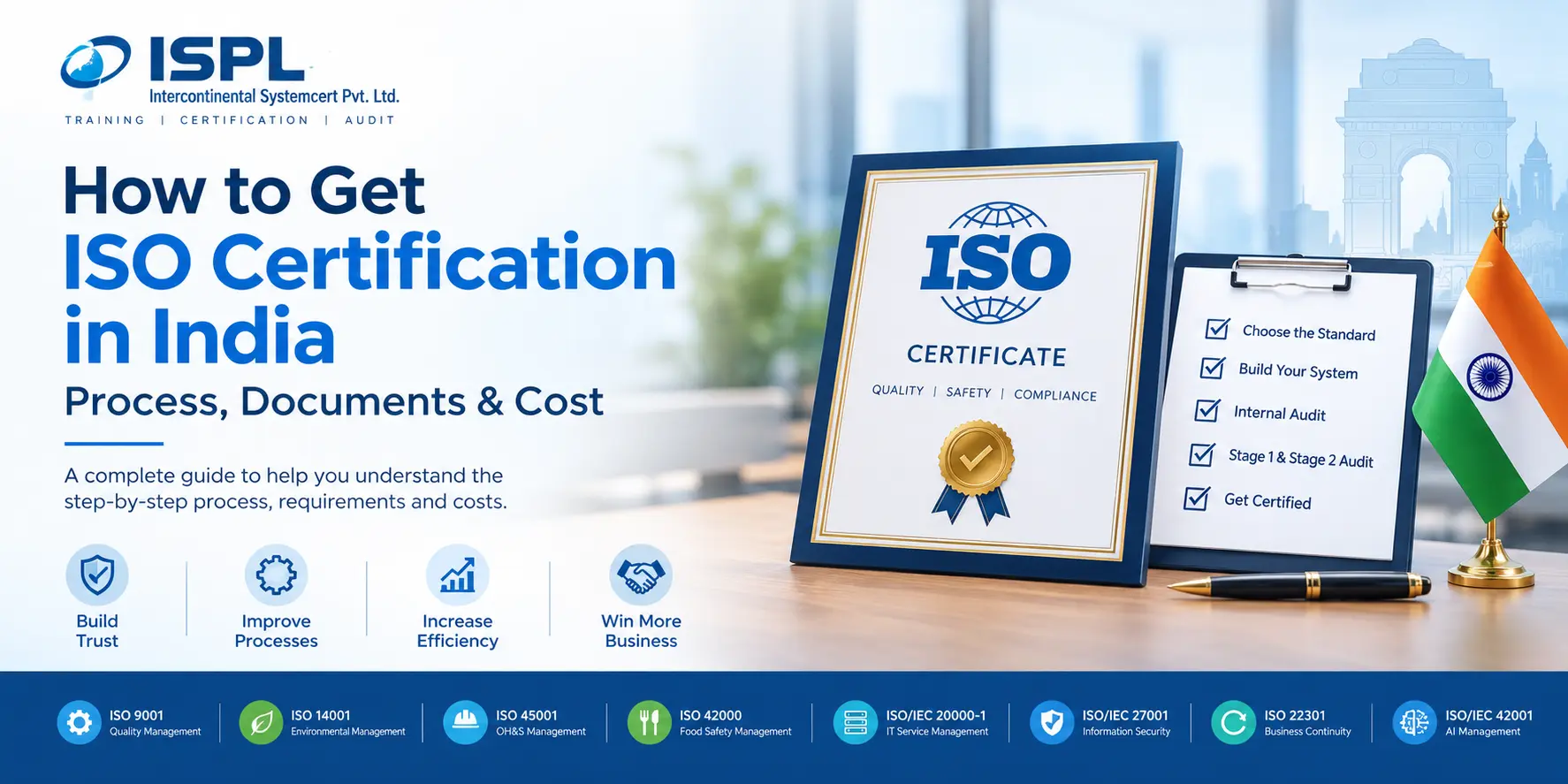
Your biggest client wants an ISO certificate before the next order. Or a tender form has a box you can’t tick. That’s usually how it starts, and it’s usually when owners google how to Get ISO Certification in India and end up more confused than before.
It’s less complicated than it looks. Below we go through the steps in order, the papers auditors ask for and what the whole thing costs. There’s also a short note on what ISPL does.
Table of Contents
Why Businesses Get ISO Certification in India
Mostly because someone else asks for it. Large buyers, government tenders and overseas customers like to know that an outside party has checked how you work.
The certificate isn’t the only payoff, though. Once your processes are written down, new staff learn faster, complaints can be traced to a cause, and the owner stops being the answer to every question. Plenty of small firms tell us that part mattered more than the paper itself.
Which ISO Standard Should You Choose?
Before you Get ISO Certification in India, be sure which standard you actually need. Look at what your customer or tender document names, not what a friend’s company holds. ISPL works with these:
- ISO 9001 for quality management
- ISO 14001 for environmental management
- ISO 45001 for occupational health and safety
- ISO 22000 for food safety
- ISO/IEC 20000-1 for IT service management
- ISO/IEC 27001 for information security
- ISO 22301 for business continuity
- ISO/IEC 42001 for AI management systems
Most companies begin with ISO 9001 because it fits almost any business. A software firm that holds client data will probably look at ISO/IEC 27001, and a food unit at ISO 22000. If you’re unsure, ask the buyer which one they mean. It can save you months.
Step-by-Step Process to Get ISO Certification in India
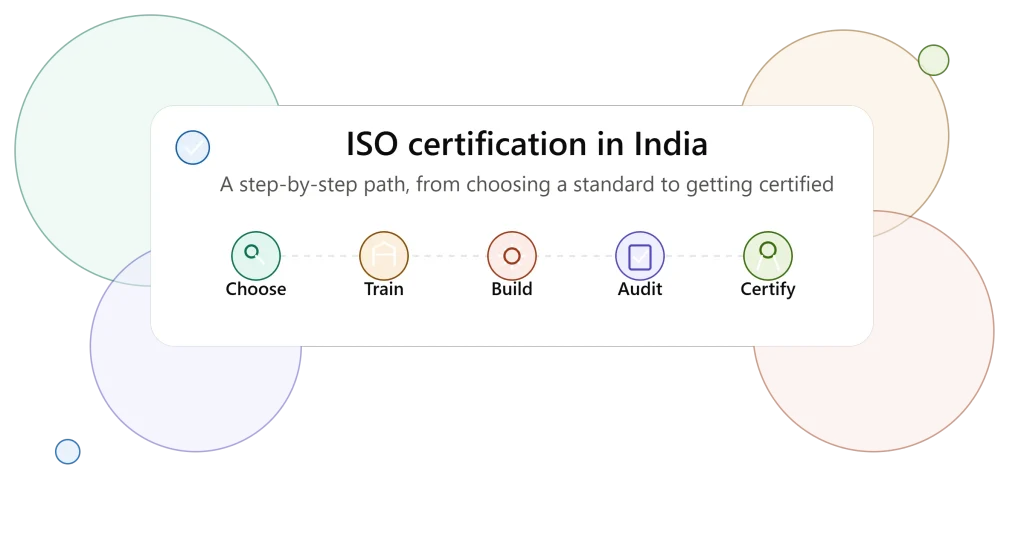
- Choose the standard. Match it to what customers or tenders are asking for.
- Train your team. People who understand the standard write better procedures, and they stay calmer during audits.
- Build the system. Write your policy, procedures and forms, and keep them true to how work really happens.
- Let it run. Auditors want proof, so give it a few weeks and collect real records.
- Audit yourself. An internal audit checks whether you follow what you wrote.
- Hold a management review. Senior people look at results and problems, and somebody notes it down.
- Pick a certification body. Choose one accredited by NABCB or another IAF-recognised body. Tenders and foreign buyers usually insist on that.
- Stage 1 audit. The auditor goes through your documents and checks you’re ready.
- Stage 2 audit. This is the site visit, where they see if you do what the papers say.
- Close the findings. Any gaps get fixed by the agreed date, and then the certificate arrives.
The certificate lasts three years, with a surveillance audit every year in between.
Documents Required to Get ISO Certification in India
You don’t need a mountain of paper, but auditors will usually ask for the following:
- Proof of business registration, like GST, Udyam or company papers
- Your scope of work and the list of sites
- An organisation chart showing who is responsible for what
- Policy and objectives
- Procedures for the key processes
- Everyday records such as training logs, customer feedback and complaints
- The internal audit report
- Management review minutes
The list shifts with the standard. An information security audit, for example, will also want risk records and details of who can access what.
How Much Does It Cost to Get ISO Certification in India?
There’s no fixed price. It depends on your size, the number of sites, the standard and how ready you are when you start. For ISO 9001, market estimates look roughly like this:
| Company Size | Approx. Total Budget (₹) |
| Up to 25 employees | 30,000 – 75,000 |
| 25 to 100 employees | 75,000 – 1,50,000 |
| 100+ employees or multiple sites | 1,50,000 – 3,00,000+ |
Standards like ISO/IEC 27001 or ISO 45001 can cost more because the scope is wider. And don’t forget the yearly surveillance audit, which often adds around ₹10,000 to ₹25,000.
Two things push the bill up fast. More locations mean more audit days, and weak records mean repeat visits. Very cheap, non-accredited certificates do exist, but tenders often won’t accept them.
How Long Does It Take?
Small businesses often wrap up in 30 to 90 days. Larger or multi-site companies may need three to six months. Get ISO Certification in India faster by keeping records updated from day one, since most delays come from missing evidence and not from the audit itself.
Mistakes That Delay You When You Get ISO Certification in India
- Copying another company’s manual without changing it
- Writing procedures nobody follows
- Skipping the internal audit or management review
- Picking a certification body only because it’s cheap
- Starting a week before the tender deadline
- Keeping top management out of the loop
How ISPL Helps You Get ISO Certification in India
We provide ISO training and audit services for companies in India and abroad, across standards like ISO 9001, ISO 14001, ISO 45001, ISO 22000 and ISO/IEC 27001. If you’re not sure which standard suits you, or you want to understand how the audit works, visit isplcmmi.com and get in touch with our team.
Conclusion
It mostly comes down to order. Pick the right standard, train your people, build a system that reflects real work and let it run before the audit. Keep your records honest, choose an accredited body and don’t rush.
When you’re ready to Get ISO Certification in India, start with a clear scope and a realistic timeline. Everything after that gets easier.
1. Q. Can a small business Get ISO Certification in India?
Yes. Standards scale with size, so a 10-person company can certify just like a large one. Its system will simply be smaller.
2. Q. Is ISO certification mandatory?
For most businesses, no. But clients, tenders and export buyers often ask for it, so in practice it becomes necessary.
3. Q. How long does an ISO certificate stay valid?
Three years from the date it’s issued, with a surveillance audit every year in between to make sure you’re still following what you documented.
4. Q. What happens if I fail the Stage 2 audit?
You don’t lose the process — the auditor lists the non-conformities found, and you get an agreed timeline to fix them. Once the corrections are verified, the certificate is issued. Very few businesses fail outright; most just need to close a few gaps.
5. Q. Can I hold more than one ISO certification at the same time?
Yes, and many companies do — ISO 9001 alongside ISO 27001 or ISO 45001, for example. Some processes and documentation can even be shared across an integrated management system, which cuts down on duplicate work.
6. Q. What’s the difference between an accredited and a non-accredited certification body?
An accredited body is recognised by NABCB or another IAF-recognised accreditation board, which means the certificate carries international credibility. Non-accredited certificates are cheaper but many tenders and overseas buyers won’t accept them — so the lower cost can end up costing you the contract.
7. Q. Do I need a consultant to get ISO certified?
Not necessarily. What actually matters is that your team understands the standard and that your certification body conducts an independent, credible audit. That’s the model ISPL follows — training your people properly and auditing your system, rather than writing your documents for you.

admin
Part of the ISPL Cert team, helping organizations achieve ISO, CMMI and international certifications.